Every PDRN Skincare Product You've Bought Has the Same Problem. Here It Is.
Salmon sperm. Fish DNA. Glass skin promises. An immunologist separates the mechanism from the marketing — and explains what the science actually supports.
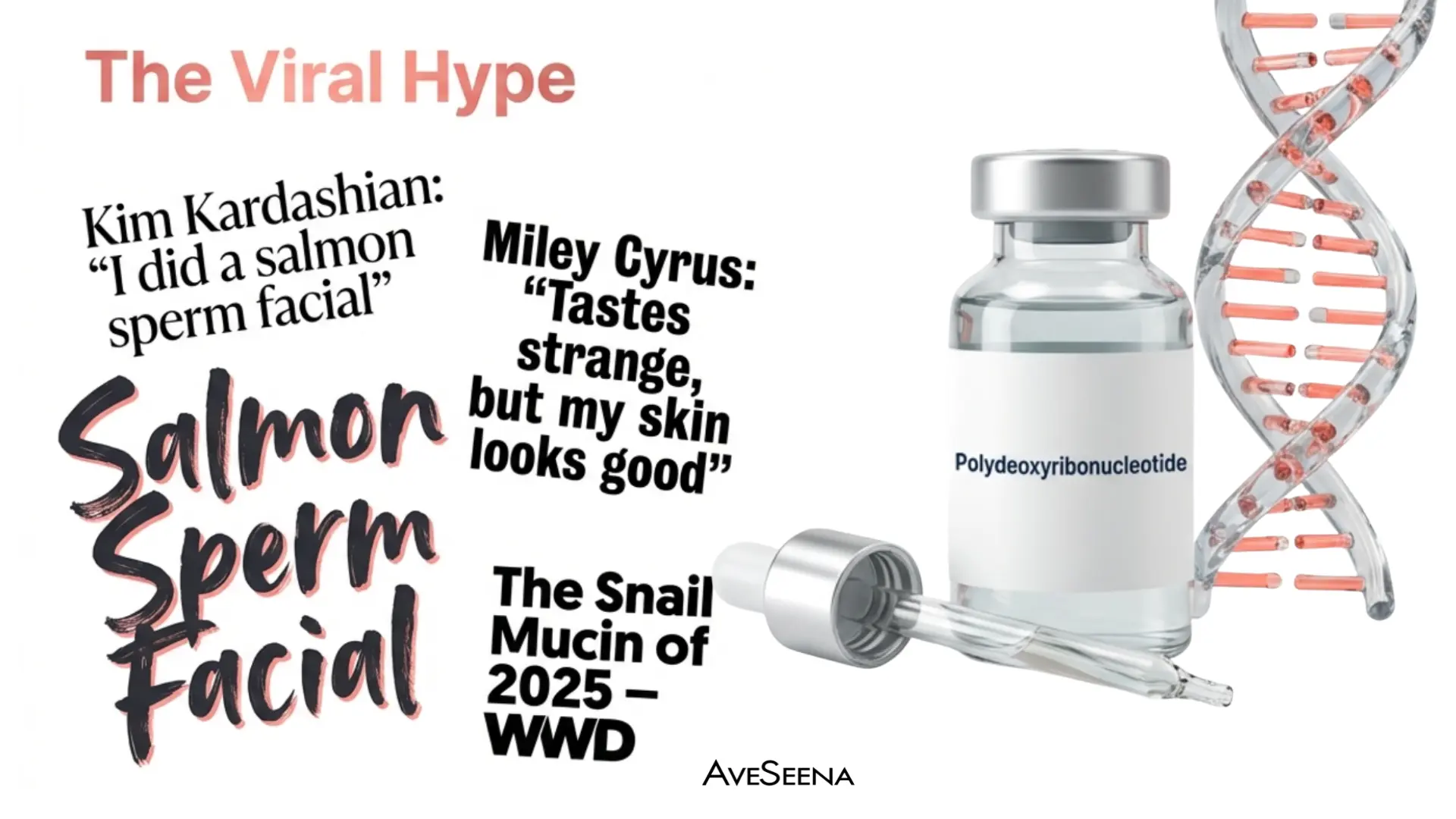
There's something almost poetic about the beauty industry's latest obsession. In our endless, Sisyphean quest for youth – the one that's taken us from vampire facials to snail mucin harvested from Korean farms – we've arrived, finally, at salmon sperm. Or more precisely, at PDRN, a fragment of fish DNA that has become the darling of K-beauty editors, the subject of breathless TikTok testimonials, and the reason Khloé Kardashian's esthetician is reportedly booked through spring.
What the marketing skips: the actives sized to reach your skin.
The whole point of this article is delivery: whether an active is small enough to reach living skin. This kit is the six AveSeena formulas built on that principle, in very generous travel sizes so you can start before experiencing the full size.
Six formulas · $25.50 · 15% off your next full size
Meet the Six That Do the WorkThe headlines write themselves, and they have. "Salmon Sperm Facials Are the Secret to Glass Skin." "Why Celebrities Are Putting Fish DNA on Their Faces." The discourse has that particular quality of modern beauty culture, part genuine curiosity, part performative disgust, part desperate hope that maybe this will be the thing that finally works. The most interesting ingredients are usually the ones that sound too strange to be true. But I've also learned that strangeness and efficacy are not the same thing, and the distance between a promising mechanism and a product that actually delivers is often wider than any marketing department would like you to believe.
So let's do something radical. Let's actually look at the science.
PDRN works when injected. The studies are real. But when applied topically — in a serum bottle — the molecule is 264 times too large to penetrate your skin. That is the entire story.
For topical skincare that addresses the same goal — supporting collagen signaling and calming the visible signs of inflammaging — the published evidence supports smaller, barrier-smart molecules like Matrixyl and niacinamide, delivered at concentrations that actually work.
That's the science. The full argument follows below.
What PDRN Actually Is
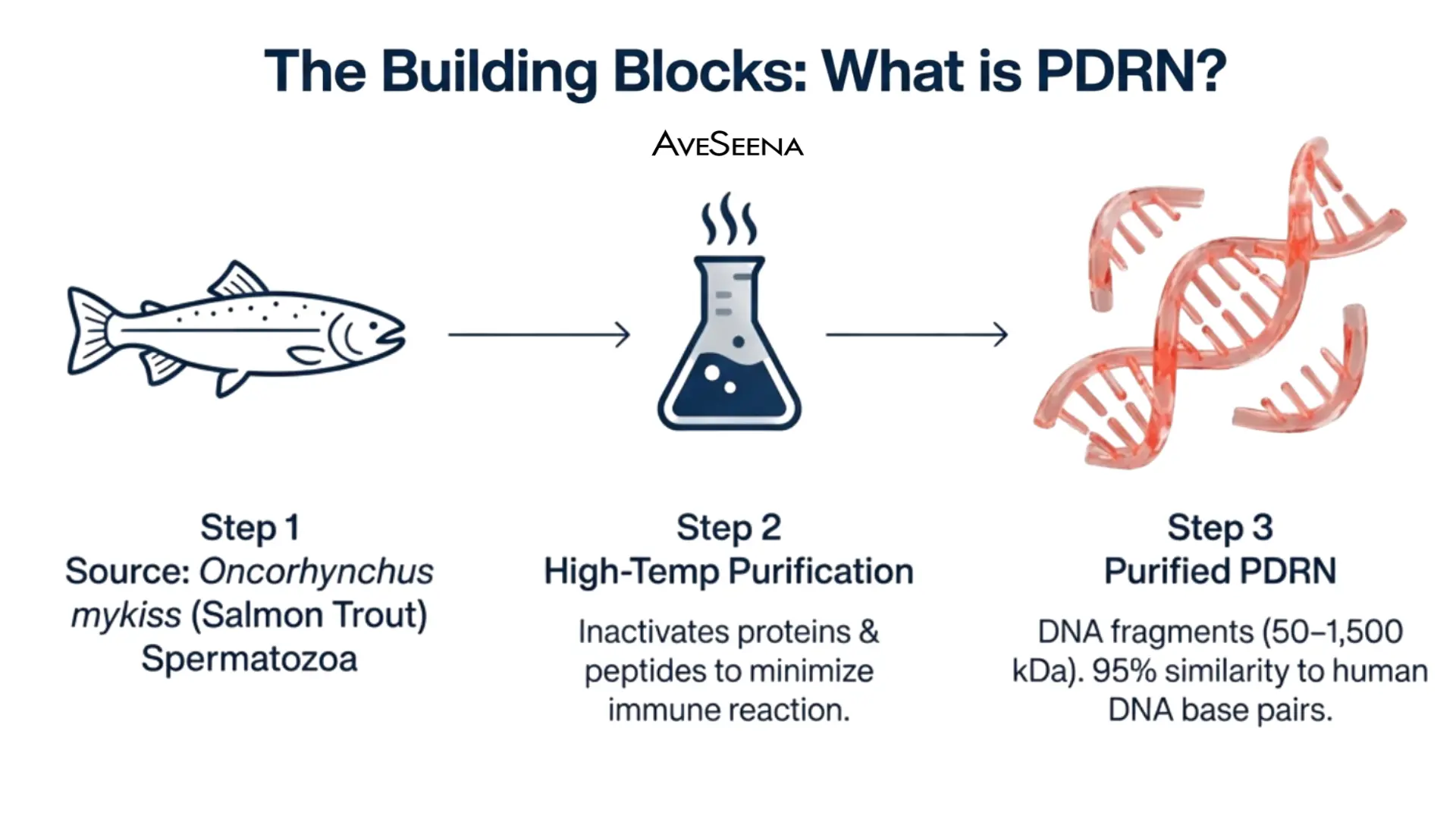
PDRN—polydeoxyribonucleotide, for those keeping score—is a DNA-based biopolymer, which is a technical way of saying it's a precisely extracted fragment of genetic material. The traditional source is the sperm of chum salmon and rainbow trout, and no, the headlines aren't sensationalizing that part.
PDRN Skincare: Quick Facts
- What it is: DNA fragments from salmon or trout sperm (or plant sources)
- Molecular weight: ~132,000 Daltons
- Skin penetration limit: 500 Daltons
- Times too large: 264x the penetration threshold
- Studies reviewed: 35+
- Studies using injection: 34+
- Studies using topical on intact skin: 0
- Mechanism: Adenosine A2A receptor activation
- Plant alternatives: Ginseng, rice, yeast-derived PDRN available
What the headlines miss is context. Before PDRN ever appeared in a serum bottle at Olive Young or a Gangnam clinic menu, it belonged to surgeons. Regenerative medicine. Chronic wound healing. Diabetic ulcers that wouldn't close. Burns that needed coaxing back to life. Its scientific credentials were established in operating rooms, not Instagram reels, and that pedigree matters—it suggests we're not dealing with pure marketing invention here. There's actual mechanism.
But mechanism and performance are different conversations entirely, and this is where things get interesting.
How It Works — In Theory
The way PDRN theoretically works represents a genuinely elegant idea. Rather than attacking wrinkles or forcing cell turnover the way a retinoid does—that scorched-earth approach we've all been taught to worship—PDRN works with the skin's existing programming.
When PDRN breaks down in the body, it releases adenosine, which activates something called the A2A receptor. Think of this as a wake-up call to cells, a signal that says time to regenerate. This stimulates fibroblasts to increase production of collagen and elastin, promotes new blood vessel formation, and reduces pro-inflammatory cytokines. Meanwhile, through what scientists call the salvage pathway, PDRN provides raw materials for DNA repair—nucleotides that cells can recycle to build new DNA without the high energy cost of creating it from scratch. Wake-up call plus repair toolkit. It's the kind of biological poetry that makes a researcher's heart sing.
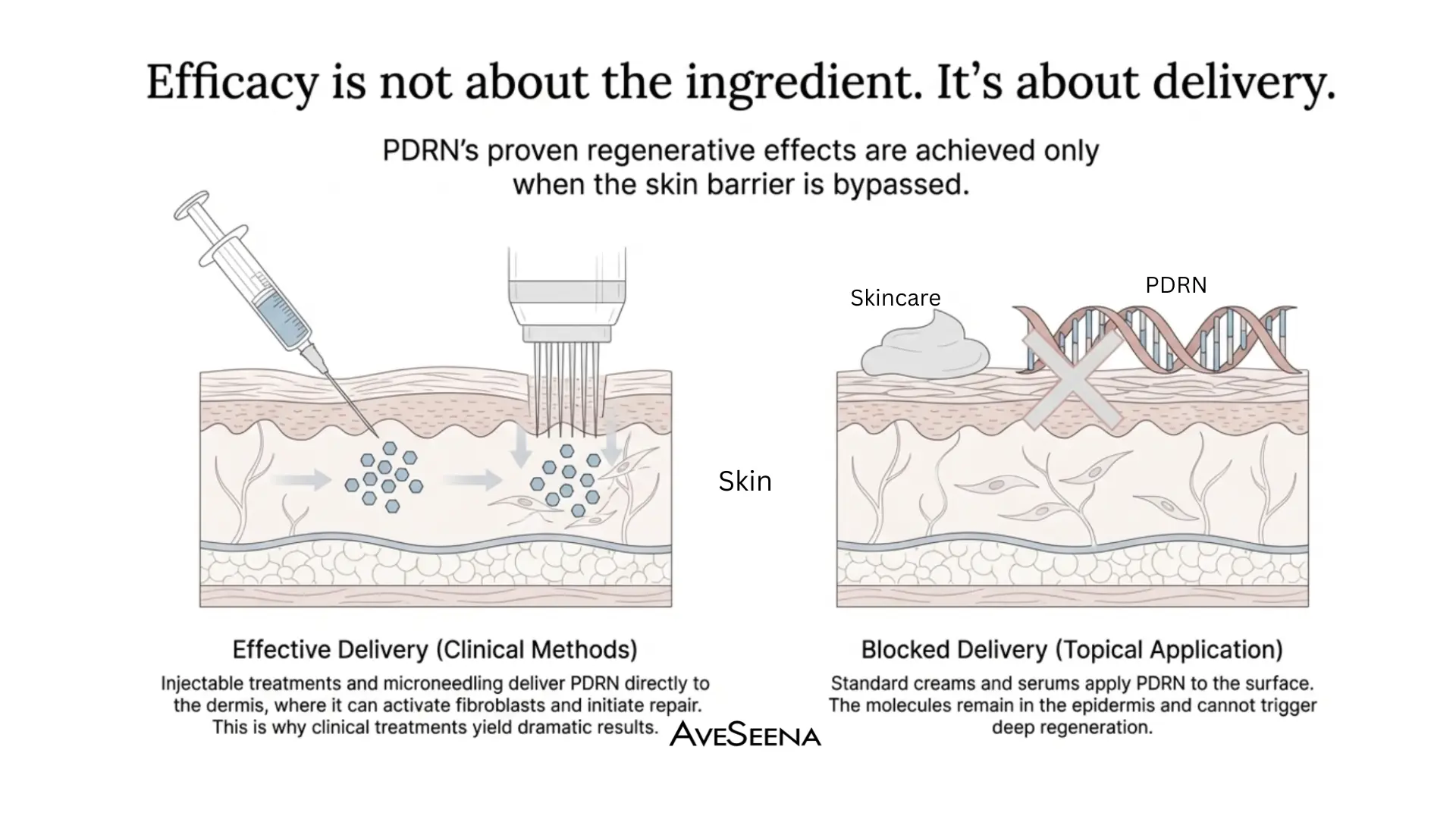
And in injectable form—where PDRN is delivered directly into the dermis, bypassing the skin's fortress-like barrier entirely—there's genuine evidence it works. Reduced inflammation. Improved wound healing. Measurable tissue regeneration. The studies are real. The mechanism is sound. The Korean clinics charging premium prices for PDRN injections aren't entirely selling fantasy.
But here's where close attention is required, because this is precisely where the marketing gets slippery.
Injectable PDRN vs. Topical PDRN
Injectable PDRN and topical PDRN serums are not equivalent treatments. The dramatic results from clinical studies cannot be expected from over-the-counter products.
| Factor | Injectable PDRN | Topical PDRN Serum |
|---|---|---|
| Delivery | Directly into dermis | Applied to skin surface |
| Skin Barrier | Bypassed completely | Must penetrate |
| Clinical Evidence | 34+ studies | Virtually none on intact skin |
| Administered By | Medical professional | Consumer at home |
| Expected Results | Clinically validated | Unproven for visible improvement |
When skincare brands cite PDRN studies to market their serums, ask one question: Was the study conducted using the same delivery method as the product being sold?
If the delivery method is topical, the molecule has to obey the rules of the skin barrier. AveSeena formulates exclusively with ingredients that pass this test — actives small enough and smart enough to reach the cells that matter.
See a Serum Tested the Way You'll Actually Use It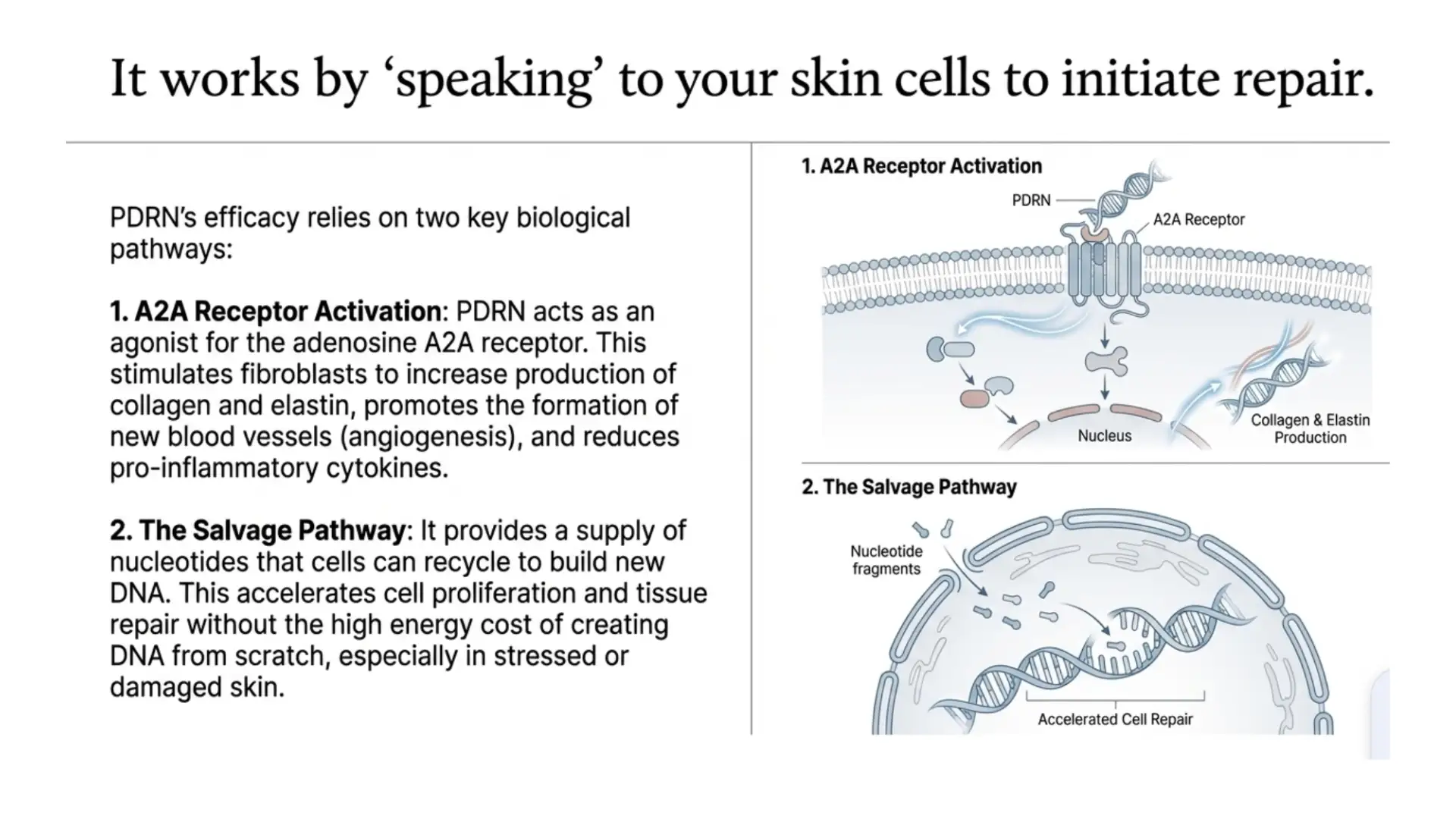
The Inconvenient Truth About Topical PDRN
The skin is a fortress. This is, biologically speaking, a feature rather than a bug—the stratum corneum exists specifically to keep things out. Pathogens. Environmental toxins. And, unfortunately for the beauty industry, many of the ingredients we'd love to deliver to deeper skin layers.
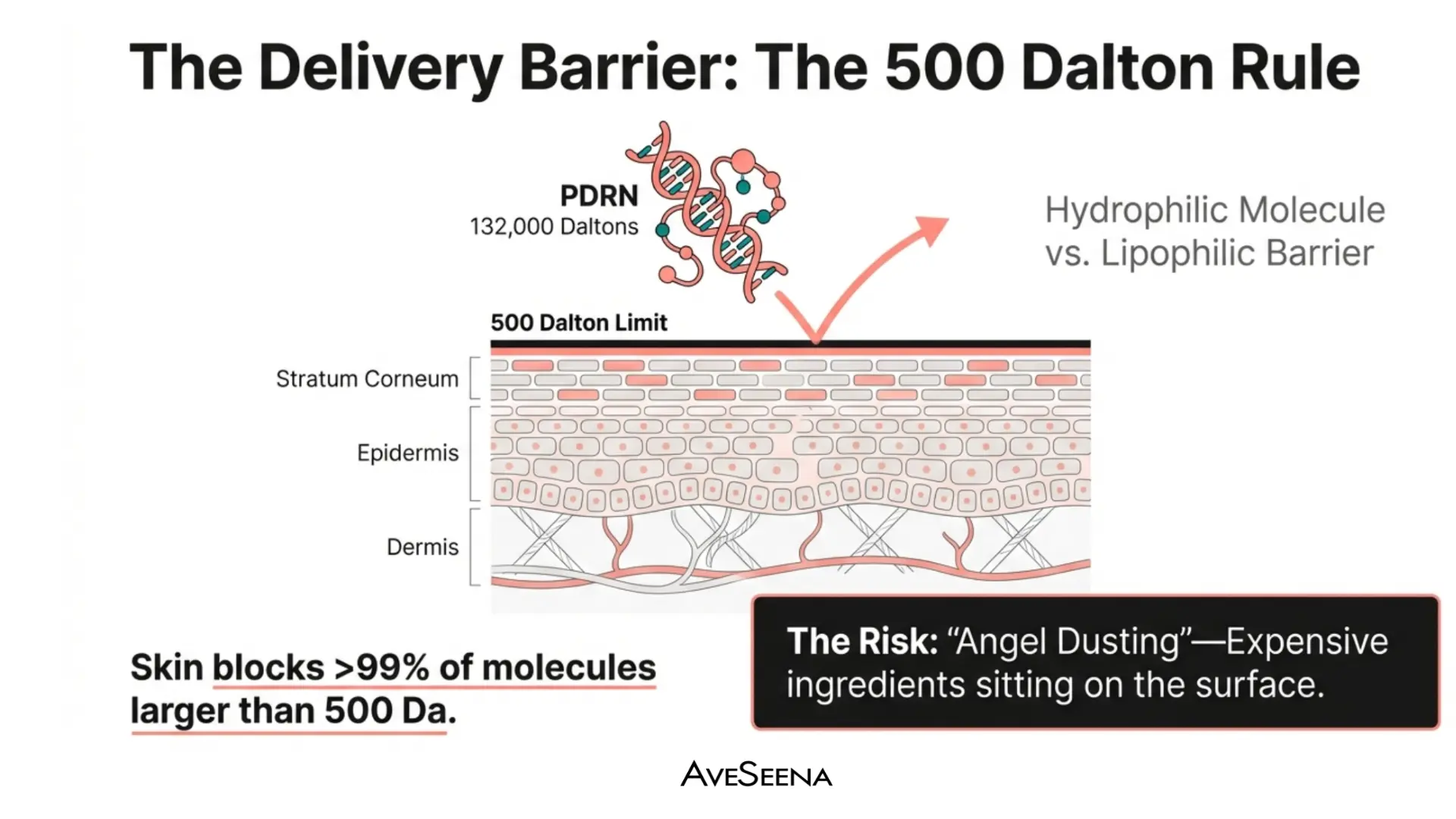
There's a general principle in cosmetic chemistry sometimes called the 500 Dalton rule: molecules above that molecular weight struggle to cross the barrier. PDRN weighs in at approximately 132,000 Daltons. It's not just above the threshold; it's orders of magnitude beyond it. Research acknowledges this directly, noting that topical PDRN's long-term efficacy is "somewhat debatable"—which is scientific understatement for we're not sure it actually gets where it needs to go. The risk? What the industry quietly calls "angel dusting"—expensive ingredients sitting on the surface, doing nothing but justifying a higher price tag.
Does PDRN Work in Skincare?
No—not as marketed. PDRN has legitimate scientific mechanisms, but its molecular weight of 132,000 Daltons prevents meaningful penetration through intact skin. All clinical studies showing visible improvement delivered PDRN via injection, not topical application.
Topical PDRN serums may provide surface hydration, but cannot deliver the cellular results demonstrated in clinical research. Those results require the ingredient to reach the dermis, which topical application cannot achieve without the skin barrier being compromised.
The 500 Dalton Rule: Why Molecular Size Matters
Molecules larger than 500 Daltons cannot effectively penetrate the skin's outer layer to reach living cells. PDRN is 264 times larger than this limit.
This is why clinical PDRN treatments use injections that bypass the skin barrier entirely.
What Actually Reaches Your Skin — and Where to Find It
| Ingredient | Realistic Delivery | Evidence Format | On AveSeena |
|---|---|---|---|
| PDRN (132,000 Da) | Injection only | 34+ injection studies | Not used (by design) |
| Matrixyl (802 Da) | Topical — palmitoylated for barrier entry | Topical studies on intact skin | Green Caviar Facial Oil |
| Niacinamide (122 Da) | Topical — easily penetrates | Extensive topical studies | Micro-Algae Immun B3 Serum |
For a topical product to have any realistic chance, it requires sophisticated delivery technology. Nano-encapsulation. Liposomes. Penetration enhancers that help shepherd the molecule through. Without these, PDRN likely sits on the skin surface, offering perhaps some hydration benefit, but little of the cellular regeneration the marketing promises. And here's the troubling part: many brands cite impressive clinical data to sell their PDRN serums, but when those studies are traced back to their source, they were conducted using injectable PDRN. The delivery method is completely different. The results are not comparable. This is, at best, a sin of omission. At worst, it's the kind of sleight-of-hand that erodes trust in the entire industry—and we wonder why women are cynical about skincare claims.
Why PDRN Is NOT in AveSeena Formulations
Given everything written above, one might expect AveSeena to be developing a PDRN serum. The ingredient is trending. It has legitimate scientific origins. It would sell. But here's the thing about building a skincare line on three decades of immunology research: shortcuts become intolerable. Uncomfortable questions become necessary. Not is this ingredient popular but can it actually reach its target and do its job.
PDRN's molecular size creates genuine absorption challenges that can't be honestly formulated around. And even if they could, the ingredient addresses symptoms rather than causes—it attempts to provide cells with repair materials, which is admirable in theory, but doesn't ask why those cells are damaged in the first place. The work at AveSeena has always focused on inflammaging, the chronic low-grade inflammation that accelerates every aspect of skin aging. When that ongoing inflammatory signaling is reduced, an environment emerges where cells can repair themselves more effectively using their own mechanisms. Address the fire, and the damage stops accumulating. It's a different philosophy entirely.
That's why the core of AveSeena is not one viral molecule, but a network of actives in the Micro-Algae Immun B3 Serum and the Matrixyl-based Green Caviar Facial Oil that target chronic inflammatory signaling and barrier health rather than patching over damage with a molecule that cannot get through the door.
Viral ingredients come and go. Snail mucin had its moment. Bee venom. Now salmon sperm. Some have genuine merit; others fade into obscurity once the algorithm moves on. AveSeena formulates based on principles that have held up across decades of research rather than chasing whatever's trending on skincare TikTok this quarter. Every ingredient earns its place through mechanism, not marketing. That's not a tagline. It's how decisions actually get made.
What Actually Works: The Case for Matrixyl
If an ingredient is going to be critiqued for poor bioavailability, it's only fair to explain what good bioavailability looks like. Enter Matrixyl—palmitoyl pentapeptide-4—a signaling peptide that tells fibroblasts to produce collagen. Same end goal as PDRN, roughly speaking, but the delivery story is completely different, and the delivery story is everything.
Matrixyl's size and structure
Matrixyl sits around 802 Daltons. Still above that 500 Dalton guideline, yes—but here's where intelligent molecular design comes in. Matrixyl is palmitoylated, meaning there's a fatty acid chain attached to the peptide, and that chain isn't decorative. It's functional. The lipophilic tail speaks the language of the skin's lipid barrier; the hydrophilic peptide portion carries the collagen-signaling sequence. Think of it as a molecule designed with a passport. It knows how to cross borders.
Topical studies, not needle studies
The size difference matters too, and not in a linear way. We're comparing roughly 800 Daltons to 132,000 Daltons. That's not a small gap—it's the difference between a kayak and a cruise ship trying to navigate the same channel. But what really distinguishes Matrixyl is this: the efficacy studies were conducted topically. The research showing collagen stimulation and wrinkle reduction used creams applied to actual skin, not injections retrofitted to marketing claims. When evaluating an ingredient, knowing it was tested in the format that will actually be used matters. Matrixyl passes that test. PDRN, in topical form, largely doesn't.
Does Matrixyl penetrate as efficiently as a tiny 300 Dalton molecule? No. But does enough reach fibroblasts to trigger measurable collagen signaling? The evidence says yes. And enough to work is the standard that matters.
How AveSeena uses it
This thinking guides every formulation decision at AveSeena — visible in the Micro-Algae Immun B3 Serum, where every active earns its place through what it can actually do, not what it sounds like it should do. The Green Caviar Facial Oil Elixir delivers Matrixyl in a lipid-rich base that works with the skin's own barrier chemistry.
Why Matrixyl Works When PDRN Doesn't
Matrixyl succeeds where PDRN fails because of two factors: molecular size and study methodology.
At 802 Daltons, Matrixyl approaches the 500 Dalton penetration threshold — close enough that its palmitoylated structure can interact with the skin's lipid barrier and facilitate absorption.
More importantly, Matrixyl's clinical studies were conducted using topical application — the same delivery method as the products you can buy. The results you see in research are the results you can expect from a well-formulated product.
What This Means for Your Skin- ✓ Supports collagen signaling for smoother-looking lines
- ✓ Pairs with niacinamide and barrier-lipids to help calm visible redness and dryness
- ✓ Designed for daily, long-term use without "treatment day" downtime
- ✓ 30-day satisfaction window · Leaping Bunny Certified · Dermatologist-tested
What's Changed Since 2025
Since this article was first published, 71 new PDRN studies have appeared in PubMed — and three developments deserve mention. Researchers have now produced low-molecular-weight PDRN from plant sources (peony, snow lotus, microalgae) that are substantially smaller than the 132,000 Dalton salmon PDRN discussed above. A late-2025 clinical study on low-MW peony PDRN showed improved periorbital skin elasticity after four weeks of topical use5 — the first published topical clinical evidence for any form of PDRN. Separately, two 2026 studies demonstrated that PDRN can be nanoformulated in PLGA particles6 or encapsulated in exosomes7 to overcome the barrier — confirming that the delivery problem is real, but not necessarily permanent. A double-blind clinical trial on microalgae-derived PDRN extract showed plumping and hydration results comparable to hyaluronic acid.8
Here is the important caveat: none of these advances are reflected in the salmon PDRN serums currently sold at Sephora, Olive Young, or Amazon. Those products still use high-molecular-weight salmon PDRN without advanced delivery technology. The low-MW plant fractions and nanoformulations exist in research labs and specialized ingredient pipelines, not in the bottles on your bathroom shelf. When a consumer brand uses low-MW plant PDRN or nano-encapsulated PDRN and publishes topical clinical data for that specific product, the conversation changes. Until then, the core argument of this article stands: for daily topical skincare, choose ingredients with the molecular size and the published evidence to match the way you will actually use them. For the science behind ingredients that do pass this test, see our guides on how peptides strengthen the skin barrier, vitamin C derivatives, and products that help with hyperpigmentation.
The Bottom Line
PDRN is a fascinating ingredient with legitimate scientific foundations—in medical wound healing. Its mechanisms are real. Its potential is genuine. But potential and performance are not the same thing, and the gap between injectable clinical results and what's sitting in a serum bottle at Sephora is wider than most marketing would like anyone to believe.
The Bottom Line on PDRN Skincare
PDRN is not a scam—it's a case of legitimate science being misapplied to sell products that can't deliver the researched benefits.
The ingredient works when injected. The studies are real. The mechanism (A2A receptor activation) is genuine. But none of that matters if the molecule can't reach your skin cells—and at 132,000 Daltons, it can't.
Before purchasing any PDRN serum, ask yourself: Am I paying for the science, or am I paying for the story of the science? The two are not the same thing.
What every woman reading this deserves is simple: the confidence to question trends, the knowledge to evaluate claims, and the understanding that skin deserves more than whatever ingredient happens to be going viral this month. That's the philosophy behind everything at AveSeena. Not chasing hype. Not promising miracles. Just rigorous science in service of skin that ages beautifully, on its own terms.
Frequently Asked Questions
Does PDRN work in skincare?
Injected, yes. As a topical serum, no, not as marketed. PDRN's molecular weight is roughly 132,000 Daltons, far too large to penetrate intact skin, so topical products cannot deliver the results shown in the injectable clinical studies. Topical PDRN may offer some surface hydration, but not the cellular regeneration the marketing implies.
Is PDRN a scam?
No. It is legitimate science misapplied. The mechanism is real and the injectable studies are real, but selling it in a topical serum, where the molecule cannot reach its target, is where the marketing and the science part ways.
What is PDRN made from?
PDRN is a fragment of DNA. The traditional source is the sperm of salmon or trout. Plant-derived and other low-molecular-weight versions now exist, but most salmon PDRN serums on the market still use the large, high-molecular-weight form.
Why can't topical PDRN penetrate the skin?
There is a general guideline in cosmetic chemistry that molecules above about 500 Daltons struggle to cross the skin barrier. PDRN is around 132,000 Daltons, roughly 264 times that threshold. Without advanced delivery technology, it largely sits on the surface.
What is the difference between injectable and topical PDRN?
Injectable PDRN is delivered directly into the dermis, bypassing the skin barrier entirely, and it has clinical evidence behind it. Topical PDRN has to cross the barrier on its own, and there is virtually no evidence it does so on intact skin. The two are not equivalent treatments.
Does AveSeena use PDRN?
No, by design. AveSeena formulates with barrier-smart actives that can actually reach their target, such as Matrixyl and niacinamide, rather than a molecule that cannot get through the door.
About the Author
Dr. Ebru Karpuzoglu, PhD is an immunologist, molecular medicine specialist, and the founder of AveSeena. Her peer-reviewed research on inflammaging, T cell biology, and endocrine-immune interactions is published in journals including Frontiers in Immunology. She formulates every AveSeena product based on three decades of laboratory and clinical research.
Scientific References:
1. Squadrito F, et al. Pharmacological activity and clinical use of PDRN. Front Pharmacol. 2017;8:224. doi:10.3389/fphar.2017.00224
2. Akaberi SM, et al. J Skin Stem Cell. 2025.
3. Khan A, et al. Chin J Plast Reconstr Surg. 2022.
4. Park S, et al. Appl Sci. 2025.
5. Bak SU, et al. Anti-aging efficacy of low-molecular-weight polydeoxyribonucleotide derived from Paeonia lactiflora. Int J Mol Sci. 2025;27(1):220. doi:10.3390/ijms27010220
6. Kang JH, et al. Nanoformulated PDRN improves anti-inflammatory and wound healing activities. Macromol Biosci. 2026;26(1):e00373. doi:10.1002/mabi.202500373
7. Chang Y, et al. A novel method to encapsulate polydeoxyribonucleotides extracted from trout into exosomes. BMC Biotechnol. 2026. doi:10.1186/s12896-026-01131-3
8. Havas F, et al. Hyaluronic acid-like skin plumping and radiance benefits of a sulfated exopolysaccharide- and natural PDRN-rich extract. Mar Drugs. 2026;24(3):99. doi:10.3390/md24030099

Molecular Immunologist & Skincare Expert
As an Immunologist trained in Molecular Medicine and as an expert in skin care and cosmetic chemistry, Dr. Ebru Karpuzoglu has spent +20 years researching skin, impact of hormones on the immune system sharing her findings in international publications with her audience, and building an award-winning line of products. Trusted by scientists, doctors, editors, bloggers, celebrities and skincare lovers around the world, her deep real-world knowledge and research are invested in every drop of AveSeena.
Disclaimer: The content on this page is for educational and informational purposes only. It is not intended as medical advice and does not replace consultation with a qualified healthcare provider, dermatologist, or physician. While we present information to the best of our ability and reference peer-reviewed scientific literature, individual skin concerns, conditions, and responses to ingredients vary