Body of Knowledge
What Is Ozempic Face and How Do You Address It?
These medications are working. The skin change that can come with rapid weight loss has a manageable answer.
If you are on a GLP-1 and you have started looking in the mirror differently around month four or month six, you are not imagining it. The medication is doing what it was designed to do. The weight is coming off. The cardiovascular benefit is real and well-evidenced (a 2023 trial of 17,604 people showed semaglutide cuts major heart events by about twenty percent). Your blood sugar is steadier than it has been in years. None of that is in question.
What is also real is the change in your face and skin alongside the wins. Researchers at Vanderbilt put hard numbers on the facial volume change in 2025. The cellular biology underneath it has been worked out across recent reviews. About twelve percent of US adults are on a GLP-1 right now, asking the same questions you are.
Should I Be Worried About Ozempic Face?
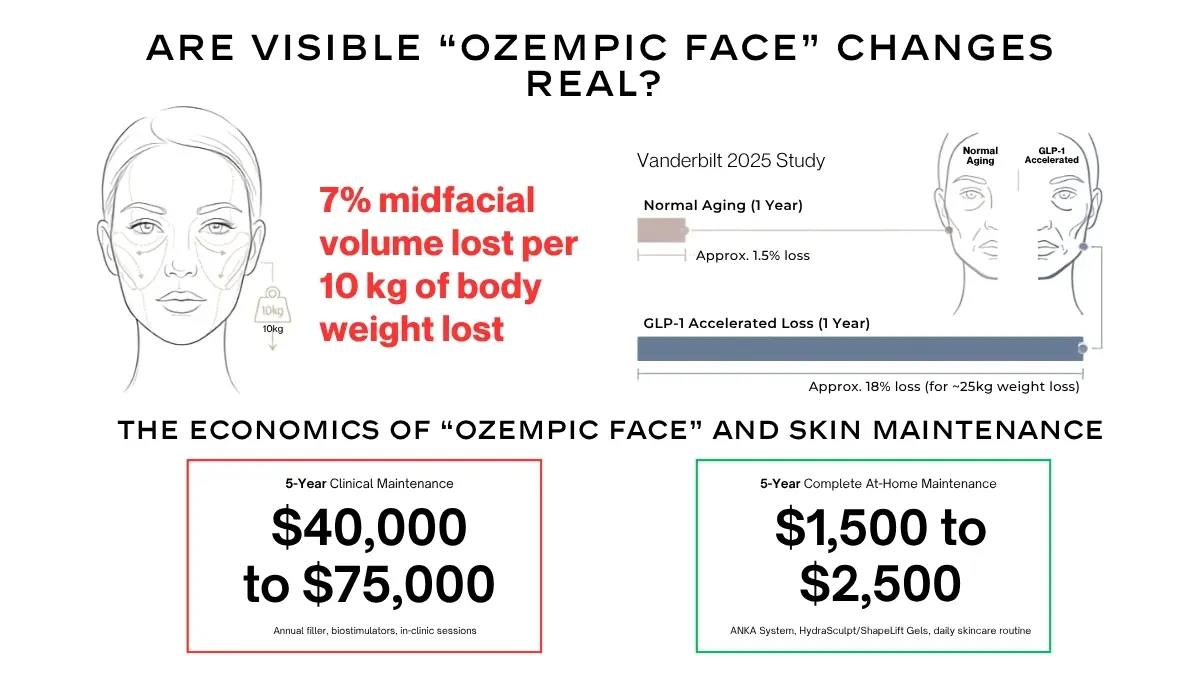
Worry less if you are losing weight slowly. Worry more if you are over forty and losing fast. A 2025 Vanderbilt study found GLP-1 users lose about seven percent of facial volume for every ten kilograms (twenty-two pounds) of body weight lost, with the loss concentrated in the fat pads closest to the surface of your skin.
The honest answer depends on three variables. How fast you are losing. How much you have lost. How old you are.
If you are under forty, losing one to one-and-a-half pounds a week under your doctor's supervision, your face will probably end up looking slimmer rather than older. The skin under your face has enough elasticity to keep up with the fat loss.
If you are over forty, losing two to three pounds a week, and you are already thirty or more pounds down, you are more likely to see what the press calls "Ozempic face." Hollow temples. Flatter cheeks. Deeper lines from your nose to the corners of your mouth. A softer jawline. The kind of under-eye shadow that does not go away no matter how much you sleep.
The data backs this up. In 2025, a team at Vanderbilt scanned the faces of twenty GLP-1 users with CT and MRI imaging before and after weight loss. They had been on the medication for about eleven months and had lost an average of eleven kilograms (twenty-four pounds). Their faces had lost an average of nine percent of midfacial volume. The linear regression worked out to about seven percent of facial volume per ten kilograms of body weight, concentrated in the superficial fat pads sitting closest to the surface of your skin.
The number that matters: 7 percent of midfacial volume per 10 kg of weight loss, concentrated in the superficial fat pads. A GLP-1 user who has lost 25 kg has, on average, lost almost 18 percent of midfacial volume in roughly a year. That same change typically takes more than a decade to develop through normal aging.
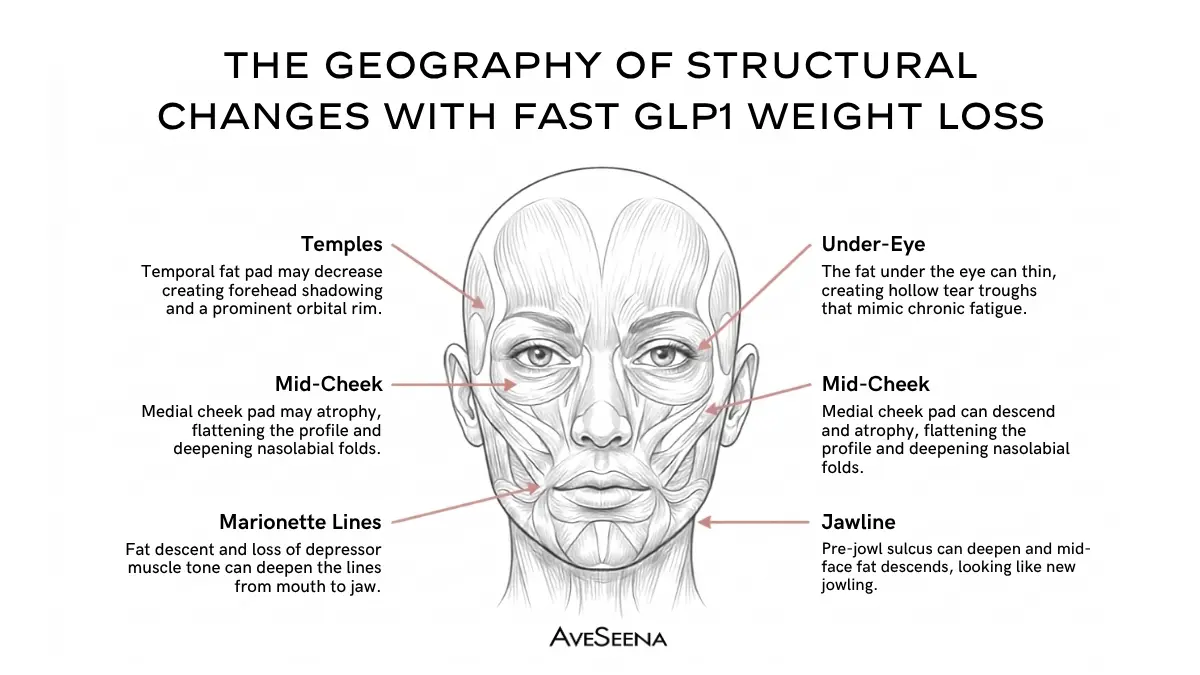
So take it seriously if you are over forty, losing fast, or already forty-plus pounds down. Worry less if you are under forty or losing slowly with your doctor's supervision. The variable that matters most is your rate of loss, not the medication itself. And the work to address it is more affordable than most people think.
The manageable answer was built for this skin pattern before GLP-1s hit the market.
See the ANKA System
Why Does Ozempic Face Happen?
Two things happen at once. Your face loses fat faster than your skin can shrink to fit. And the medication itself may affect the cells in your skin that produce collagen and elastin, on top of the fat loss.
The simple half is mechanical. Your face stores fat in distinct compartments. One in your cheek. One under your eye. One behind your eyebrow at the temple. One below your cheekbone. These compartments hold their shape because of the fat inside them. When that fat empties fast, the skin that used to drape across a full compartment now drapes across an empty one.
That is why hollow temples, flat cheeks, and tear-trough shadows show up on GLP-1 users. A 2024 anatomical review mapped the pattern: the medial cheek, the under-eye fat compartment, and the temple fat pad are the three areas hit hardest.
The more interesting half is cellular. A 2025 review pulled together everything the lab science has documented since 2015 about how GLP-1 receptors affect skin cells. The proposal: GLP-1 receptors sit not only on your pancreas (which is what the medication targets) but also on stem cells in your skin and the fibroblasts that produce your collagen. When the medication activates those receptors, the cells may slow down their normal protective work. Less cellular fuel. Less collagen support. More oxidative stress on the fibroblasts.
The original lab paper underneath all this is from 2015. Researchers took human fat stem cells from people undergoing weight-loss surgery and exposed them to liraglutide (a sister GLP-1 medication). The cells slowed their growth by about forty-five to fifty percent. The effect reversed when the researchers blocked the GLP-1 receptor, confirming the pathway. The lab evidence is real. Whether it explains the full face change in living humans is still being studied, but the mechanism is plausible.
Why this matters for what you do next: if the only mechanism were fat loss, the answer would just be filler. Filler refills the architecture. But filler does not do anything for the cellular slowdown. Patients who only get filler often look corrected but still feel like their skin looks older. That is the cellular half showing through.
Will It Snap Back If I Just Wait, or Is Ozempic Face Permanent?
If you are under forty and you lost weight slowly, some snap-back over six to twelve months is possible. If you are over forty or you lost more than twenty kilograms (forty-four pounds), waiting alone usually does not work. Your skin does not fully rebuild itself once the collagen has been lost.
This is the question that gets asked most in GLP-1 user communities, and the honest answer is more nuanced than what most dermatologists tell you.
Under thirty, twenty pounds lost over a year on a low dose? Your skin has enough elasticity to mostly catch up. You will look slimmer rather than older. Wait six months and see.
Over forty, sixty pounds lost in eight months? Your skin does not have enough elastin to retract that fast. The compartments do not refill. The collagen your skin failed to build during the medication period does not come back on its own. The change is real, and it is persistent without intervention.
"Permanent" is the wrong word, though. "Persistent" is closer to the truth. A 2025 case series treated twenty-four people with subdermal radiofrequency for the laxity from Ozempic face. Most reported high satisfaction. The change responds to intervention. It does not fix itself.
The companion question that always follows: will my face come back if I stop the medication? Partially. The cellular slowdown the medication appears to cause likely reverses over six to twelve months after stopping. The visible changes accumulated during the year or two on the medication do not reverse on their own.
And: will my skin tighten if I regain weight? Partially again. Your fat compartments can refill when you regain weight. Your skin envelope, which stretched during the original weight gain and loosened during the loss, does not fully retighten by itself. Most people who regain weight after a GLP-1 round end up with a fuller face that still reads as aged on the skin quality side. The fat comes back. The skin quality does not, unless you actively work on it.
The honest takeaway: do not stop the medication over a cosmetic worry. The cardiovascular and metabolic benefit is real. But also do not wait passively for the skin change to fix itself. That is not how this biology works after forty.
Can I Do Anything During Weight Loss to Prevent It?
Yes. Three things compound. Slower rate of loss, resistance training plus protein, and starting at-home skin support from month one of your medication produces a different month-twelve face than waiting for visible changes.
None of these three are heroic on their own. Together they change the outcome significantly.
One: slow your rate of loss. Talk to your prescribing doctor about a dose that produces half a pound to one pound of loss per week instead of two to three. You will reach the same goal a few months later. Your face has time to adapt. The 2025 Vanderbilt study reported the nine-percent volume loss in people losing about a kilogram per week. Lose at half that rate and the volume change halves with it.
Two: keep your muscle. Roughly twenty-five to forty percent of weight lost on a GLP-1 is muscle rather than fat unless you actively push back. Resistance training (twice a week minimum) plus protein at about one gram per pound of your goal body weight protects facial muscle along with the rest. The platysma, the buccinator, the zygomaticus, these are the muscles that hold your skin envelope from underneath. Losing them makes the skin look looser even when the fat loss is identical.
Three: start the skin work at month one. This is the part most people skip until they see the change in the mirror. The cellular slowdown the Paschou review describes appears to start in the first weeks of GLP-1 therapy. The visible changes take months to show up, but the underlying biology starts immediately. If you wait until you see the change to start the skin work, you have already lost months of compounding.
The home-use clinical data is consistent across studies: visible improvement at eight to twelve weeks of consistent device use, two to three times a week. Start at month one of your medication. By month twelve, you have offset much of the cellular slowdown that would otherwise have produced the full visible change. This is the GLP-1 user who reaches goal weight and still recognizes herself in the mirror. Slower rate. Muscle preserved. Skin worked from week one.
How Do I Fix the Sagging Around My Jaw and Neck? What Actually Works for Loose Skin?
Three categories of treatment work. Filler or fat grafting refills the empty fat compartments. Energy-based devices (in-clinic or at-home) work on the skin quality and the cellular pathway. Topical care supports the surface. Filler-only is the most common mistake.
There are three honest categories. Each addresses a different part of the problem. Most GLP-1 users need at least two.
Refill the architecture (clinical only)
This is filler, biostimulators like Sculptra, or autologous fat grafting. They replace volume in the empty compartments. The 2026 Allergan Aesthetics survey found that eighty-one percent of providers treating GLP-1 users use hyaluronic acid filler as their primary tool. Cost: $600 to $1,200 per syringe, with most GLP-1 users needing four to eight syringes for the initial correction and two to four annually for maintenance. The 2024 American Academy of Facial Plastic Surgery survey reported a fifty-percent jump in fat grafting procedures, attributed largely to GLP-1 users. Fat grafting is more expensive upfront ($5,000 to $15,000) but the results last five to ten years.
Stimulate the skin (in-clinic and at-home)
This is where the cellular work happens. Energy-based devices, radiofrequency, ultrasound, microcurrent, red light, work on your skin's own collagen production rather than adding volume from outside. A 2025 case series specifically treated Ozempic face with subdermal RF and reported high satisfaction. At-home versions of these technologies have a decade of clinical data behind them: a 2016 home RF study, a 2023 red LED study, a 2012 facial muscle stimulation trial, and a 2024 systematic review covering eighteen home device studies. Visible change at eight to twelve weeks of consistent use is the consistent finding.
Support the surface (topical only)
Vitamin C in the morning. Retinoid two to three nights a week. Peptides. Sunscreen every day, non-negotiable. Adequate dietary protein. Hydration. These do not replace the other two categories but they amplify both.
The mistake most GLP-1 users make
Filler-only. They get the architecture refilled. The face looks corrected in photographs. But the skin quality still looks aged because the cellular pathway is still suppressed. That is the cellular half the filler does not touch, and it is why so many GLP-1 users keep going back to their dermatologist confused about why the work is not lasting.
The smart combination for most GLP-1 users
Selective filler at one or two highest-impact zones (usually temples and tear troughs) plus daily at-home skin work for the cellular and skin quality pathways. The clinical part addresses what at-home cannot reach (volume). The at-home part addresses what filler cannot reach (the cellular pathway). Together they run about $1,500 to $4,500 a year. Filler-only at full clinical maintenance runs three to five times that.
Six modalities. Face and body. One device.
See the ANKA SystemWhere Does GLP-1 Hit Hardest on Your Face?
Five zones do most of the visible work. Temples. Mid-cheek. Jawline. Marionette lines around the mouth. Under the eyes. The under-eye and temple changes are usually the first thing you notice in your own photos.
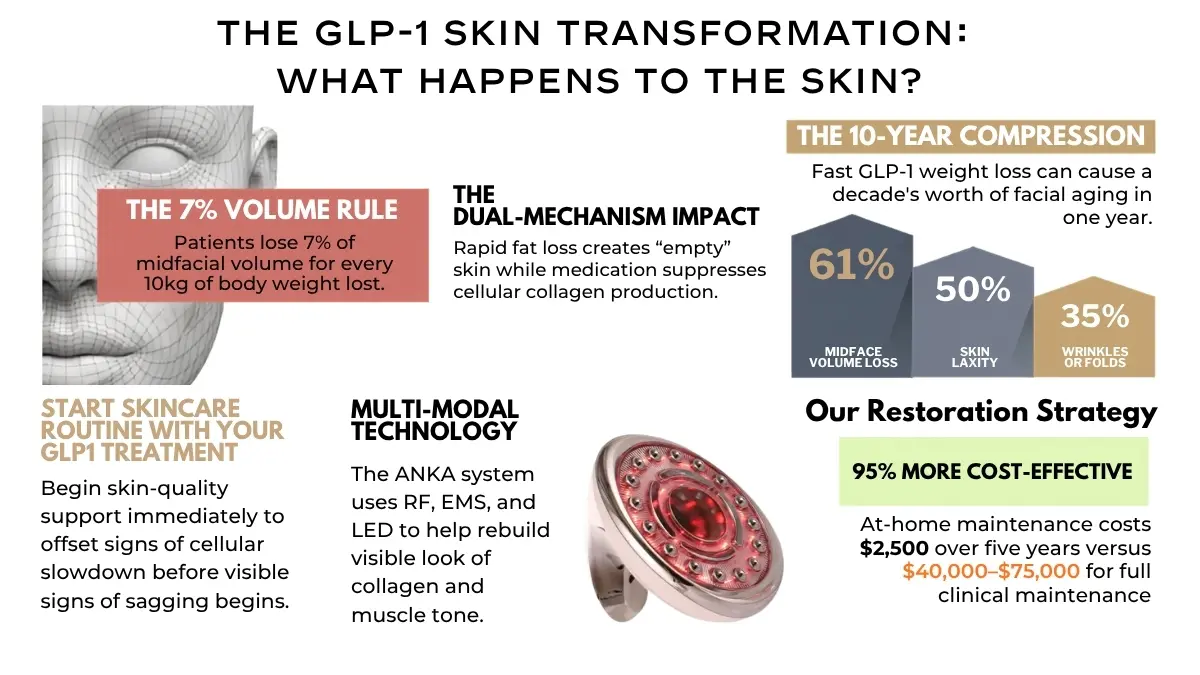
GLP-1 weight loss does not hit your whole face evenly. Five anatomical zones do most of the visible work. Recognizing which one is changing tells you what kind of support it needs.
The temples
The fat pad behind your eyebrow at the temple is one of the first to deflate. The result reads as a shadow on the side of your forehead and a more prominent bony orbital rim that ages your upper face. Surface skin work can support the envelope around the empty compartment but does not refill it. For dramatic temple hollowing, filler at this single zone is high-impact.
The mid-cheek and zygomatic arch
The medial cheek pad is the single biggest contributor to the flattened mid-face look. As it descends and atrophies, your cheek goes from convex to flat or concave, and the nasolabial fold from the side of your nose to the corner of your mouth deepens. Energy-based skin work in this zone responds well because there is substantial surface area and the muscle layer underneath responds to EMS.
The jawline and pre-jowl sulcus
The small dip in front of your jowl is where mid-face fat descent meets a relaxed platysma muscle. Combination work, RF for the collagen rebuild and EMS for the muscle re-education, does most of the visible heavy lifting here.
The marionette lines and corners of the mouth
The line that runs from the corner of your mouth toward your jaw deepens with mid-face fat descent and loss of muscle tone in the depressor anguli oris. Combined RF, EMS, and red LED in the same session is what produces the most visible change.
The under-eye and tear trough
The under-eye fat thins on GLP-1 therapy, producing the hollow look that reads as fatigue regardless of sleep. This is the thinnest skin on your face, so device intensity has to be lower and session time shorter. Eye-specific devices and dedicated under-eye patches outperform full-face devices in this particular zone.
How Long Until I See Changes From At-Home Devices?
Eight to twelve weeks of consistent use is what the home-device clinical literature reports. Visible results before week four are uncommon and usually just hydration, not real structural change. Most people who stop their routines quit between weeks six and ten, right before the structural change becomes obvious.
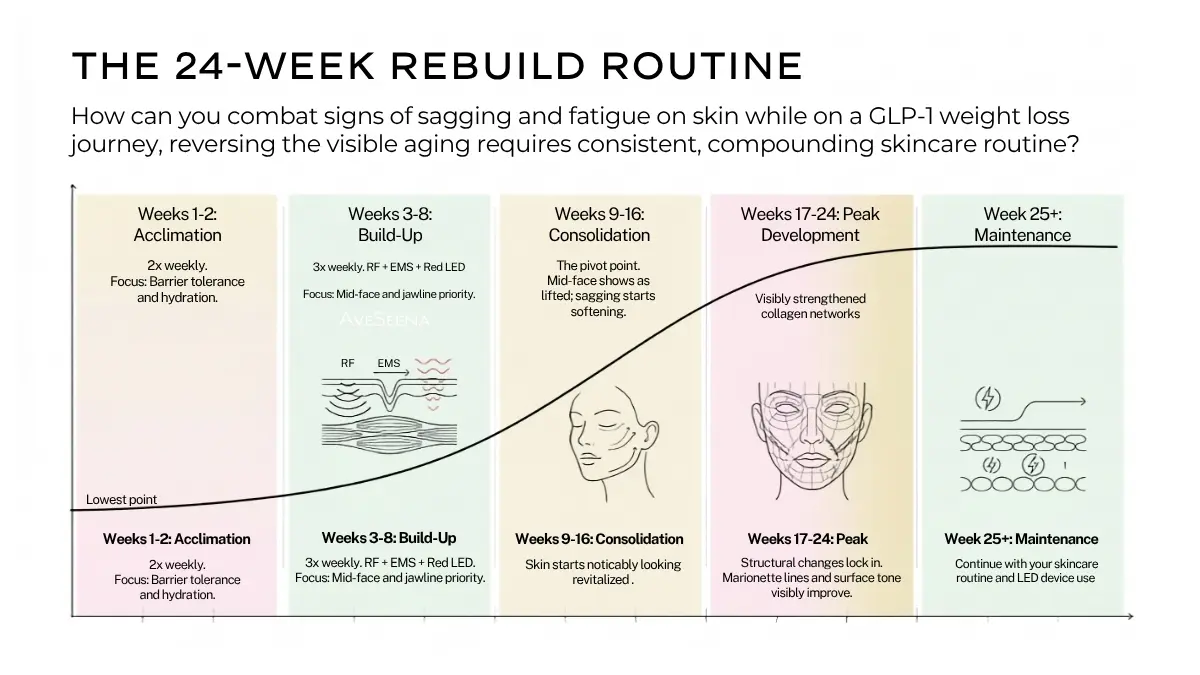
At-home devices work, but they work on a timeline. Here is the realistic six-month roadmap.
Weeks 1 to 2: Acclimation
Two short sessions a week. Lowest intensity. Eight to ten minutes each. The goal is to confirm your skin tolerates the protocol without redness lasting more than two hours or persistent stinging. HydraSculpt Conductive Face Gel for face work. ShapeLift for body. Sunscreen daily, non-negotiable.
Weeks 3 to 8: Build-up
Three sessions a week. Each session combines RF and EMS in the same pass, with red LED dwell at the end. Mid-face and jawline as priority zones. Sessions lengthen to twelve or fifteen minutes as tolerance builds. On non-device nights: vitamin C in the morning, retinoid at night.
Weeks 9 to 16: Consolidation
Same three-times-weekly cadence at medium intensity. This is the window when most clinical studies report visible change. Your mid-face starts photographing as more lifted. The pre-jowl sulcus softens. Most people who stop their routines stop in this window because the early hydration plateau passes before the structural change becomes obvious. Continuing is the point.
Weeks 17 to 24: Peak development
The structural changes consolidate. Cadence holds. Skin envelope quality continues to improve. By end of week 24, the cumulative effect on jaw definition, marionette line depth, and overall surface tone is visible without measurement.
Week 25 onward: Maintenance
Two device sessions a week, indefinitely. The biology that produced your week-24 result is still active because the medication is still active. Stopping the work reverses the gains over several months.
What Does This Actually Cost Compared to Going to a Clinic?
Five years of full clinic maintenance for GLP-1 facial change runs $40,000 to $75,000. Five years of a consistent at-home routine runs under $2,500. The at-home approach is three to six percent of the clinic cost and addresses the cellular pathway that filler alone does not reach.
The cost conversation rarely happens in a dermatology office. Here it is.
Full clinical maintenance, the way most aesthetic providers structure it, per year:
Filler at two to four syringes: $1,500 to $4,500. Biostimulator series factored every eighteen months: $700 to $1,400. One in-clinic energy session like Ultherapy, Sofwave, or Morpheus8: $2,000 to $4,500. Topical maintenance: $400 to $1,000. Annual total: $4,600 to $11,400. Five-year total: $40,000 to $75,000 in a typical full-maintenance scenario.
At-home alternative, five-year cost: the ANKA Face and Body Treatment System once. HydraSculpt and ShapeLift Conductive Gels replaced as used. Standard topical care continued. Five-year total: $1,500 to $2,500.
This is not an argument that at-home replaces clinical care in every case. For severe volume loss in the temples or mid-cheek, you will still benefit from selective filler at those specific zones. The architecture is real and at-home does not refill empty fat pads. The argument is that the daily skin quality work, which is what addresses the cellular mechanism the medication keeps activating, is where at-home wins by an order of magnitude. The smart approach: targeted filler at one or two high-impact zones, plus daily at-home work for the cellular pathway. The expensive approach: clinic-only, indefinitely.
Does Collagen Help? What's the Best Skincare for Ozempic Face?
Oral collagen helps a little. Topical care helps more. The high-leverage daily moves are vitamin C in the morning, a retinoid two to three nights a week, peptides, and broad-spectrum sunscreen every single day. Skip the GLP-1-branded serums; they are standard formulations at a premium price.
Oral collagen supplements do something. Meta-analyses of clinical trials report modest improvements in skin elasticity and hydration over twelve to twenty-four weeks of consistent intake. The effect is small. For a GLP-1 user losing weight quickly, food-source protein is more important than supplement protein, and supplement collagen is a secondary layer rather than a primary one.
The AveSeena routine for GLP-1 users, in the order to apply:
Gentle Gardenia Anti-Pollution Gel Cleanser. pH-balanced, non-stripping cleanser with SAP-form Vitamin C and botanical antioxidants. AveSeena uses stable Vitamin C derivatives (THD and SAP) instead of classic L-ascorbic acid: both tolerate the skin barrier without disruption over long-term use.
Micro Algae Immun B3 Serum morning and night, after cleansing. Concentrated niacinamide (Vitamin B3) with sea-derived micro-algae actives, plant-derived peptides, glycerin, Cica, aloe vera, bearberry, and licorice. Niacinamide supports the skin barrier and signals fibroblasts. The peptides signal collagen and elastin renewal. Over 96 percent natural origin, fragrance-free.
Ageless Perfection Cream morning and night, after the serum. Niacinamide, Sodium Ascorbyl Phosphate (a stable Vitamin C derivative), shea butter, jojoba, squalane, and Tremella fuciformis mushroom extract for hyaluronic-acid-like surface hydration. Gel-cream texture hydrates for up to twenty-four hours and reinforces the skin barrier. Formulated for the delicate skin of face, neck, and décolleté.
Green Caviar Facial Oil Elixir as the night seal. Tetrahexyldecyl Ascorbate (THD-form Vitamin C in a lipid base), bakuchiol as AveSeena's plant-based alternative to classic retinoids (retinoids can drive inflammation in skin that is already cellular-stressed from rapid weight loss), Matrixyl 3000 with palmitoyl tripeptide-1 and tetrapeptide-7 for collagen and elastin signaling, squalane, camellia oil, and green caviar algae oil whose structure mimics hyaluronic acid. Apply two to three drops over the moisturizer.
Honeyactive Beauty Mask once or twice a week. Concentrated honey, French kaolin, and cold-pressed camellia, sunflower, and castor seed oils. Helps the appearance of dull skin and the visible signs of inflammaging.
The single most important topical for a GLP-1 user is sunscreen. UV breaks down collagen through the same pathways the medication is suppressing. Adding sun damage on top of pharmacological skin change accelerates the visible aging significantly. Broad-spectrum SPF 30 minimum, every morning, on face, neck, chest, and the backs of your hands.
For ANKA device users, the conductive gels are your primary topical at session time. HydraSculpt Conductive Face Gel was formulated to help the appearance of skin showing the visible signs of inflammaging on the face. ShapeLift Conductive Body Gel was formulated for the same pattern on body skin: arms, abdomen, inner thighs, chest. Both conduct the device energy and deliver supportive actives at the same time.
What does not help: aggressive exfoliating acids during active weight loss (your barrier is already stressed), expensive products without active ingredients backed by published evidence, and the GLP-1-branded serums that have appeared in the last two years. The ingredients in those products are mostly the same vitamin C, peptides, and hyaluronic acid you can get for less, repackaged with premium marketing.
Why Was AveSeena Built for This Skin Pattern?
First the important part: GLP-1 medications are net-positive for the users who need them. Do not stop your medication over a cosmetic worry. AveSeena was developed around inflammaging research, the broader field studying how skin cells age through stem cell decline, mitochondrial slowdown, and oxidative stress. The same supportive technologies apply when GLP-1 weight loss accelerates the visible cellular pattern.
First, the part that matters most: GLP-1 medications are net-positive for the people who need them. The cardiovascular benefit is real and well-evidenced. The metabolic benefit is real. The weight loss itself is life-changing for many people. The skin change this guide addresses is one variable to manage, not a reason to question the medication.
Now the biology underneath, in plain terms.
Inflammaging is the name researchers have given to a slow, low-grade form of inflammation that drives normal skin aging at the cellular level. Over decades, it produces stem cell decline, mitochondrial slowdown, oxidative stress on the cells that make your collagen, hormonal shifts (especially estrogen decline in women), and the build-up of damaged proteins called advanced glycation end products. The visible result is the skin you see in older relatives: thinner, drier, less elastic, with less collagen and less fat under the surface. This is the broader research field that describes how adult skin ages.
The proposed mechanism behind the cellular half of GLP-1 facial change has been worked out across reviews in 2024 and 2025: suppression of fat stem cells in your skin, less cellular fuel for the fibroblasts that make your collagen, more oxidative stress on those same fibroblasts, and lower indirect estrogen production from the dermal fat layer. Some of these pathways overlap with cellular features that inflammaging research also describes. Whether that means a shared underlying biology or two pathways that happen to look similar is still being studied. The honest framing is plausible overlap, not established equivalence.
What is settled is more useful. The same supportive technologies that have been studied for skin biology over the past two decades happen to address the cellular features GLP-1 users see in the mirror. Red light supports mitochondrial function in your skin cells. Radiofrequency triggers your fibroblasts to make more collagen. Microcurrent stimulation addresses muscle tone and cellular energy. Peptide signaling and antioxidant topicals are well-evidenced. The technology category works for GLP-1 users because the cellular biology it supports is the same biology, regardless of how the upstream research on causation resolves.
"GLP-1 medications do what they were designed to do. The visible skin change responds to a separate set of interventions that run on different biology. They do not have to compete."
Dr. Ebru Karpuzoglu, AveSeena founderAveSeena was built around this research years before the first off-label semaglutide prescription was written. The ANKA Face and Body Treatment System, the HydraSculpt and ShapeLift Conductive Gels, the broader formulation portfolio were developed for skin showing the visible signs of inflammaging in adults reaching that pattern through normal aging. Patients on GLP-1 medications see overlapping visible changes faster. The same supportive technologies apply. The brand did not pivot to chase the GLP-1 wave. The science was already here. The wave walked into it.
The science was already here. The GLP-1 wave walked into it.
Shop ANKA System HydraSculpt Face Gel ShapeLift Body GelWhat Else Should I Know?
Can you reverse Ozempic face?
Reverse is the wrong word. The accurate question is: can you address what shows. Lost facial fat does not come back at adult timescales without active intervention. Filler refills it. Biostimulators stimulate your skin to produce more collagen. Energy devices stimulate your fibroblasts directly. Topical care supports the surface. All of these work. None of them happen by waiting.
Does Ozempic face go away if I stop the medication?
Stopping the medication addresses the cellular slowdown going forward. It does not undo the visible changes that have already accumulated. The compartments that emptied do not refill. The collagen your skin did not build during the medication months is not retroactively built. People who continue at-home work for six to twelve months after stopping the medication recover better than people who do nothing, because the cellular pathways can rebuild collagen once the suppression lifts and the skin is supported.
Will my skin tighten if I regain weight?
Partially. Your fat compartments can refill when you regain weight. The skin envelope that stretched during the original weight gain and loosened during the loss does not fully retighten on its own. Most people who regain weight end up with a fuller face that still reads as aged on the skin quality side. Active intervention is what tightens the envelope. Weight regain alone does not do it.
Will this work for Mounjaro and Zepbound too, not just Ozempic?
Yes. The cellular mechanism studies focus mostly on semaglutide and liraglutide, but all GLP-1 receptor agonists share the same receptor pathway. The clinical pattern of facial change has been documented across semaglutide (Ozempic, Wegovy), tirzepatide (Mounjaro, Zepbound), and liraglutide (Saxenda). The protocol logic applies to all of them.
Why does AveSeena's research apply to GLP-1 skin change?
AveSeena's product line was developed around inflammaging research, which studies how skin cells age through stem cell decline, mitochondrial slowdown, and oxidative stress. GLP-1 users see skin changes involving some of the same cellular features. The same supportive technologies (red light, radiofrequency, peptides, antioxidants) work because they support the underlying cellular biology, not because the conditions are equivalent. The brand serves GLP-1 users because the supportive technology is what they need, regardless of how the upstream research on causation eventually resolves.
Should I tell my prescribing doctor I am using the ANKA system?
Yes, but mostly for completeness rather than safety. There are no documented contraindications between GLP-1 medications and home radiofrequency, microcurrent, or LED therapy. The mechanisms operate independently. Standard contraindications to home energy devices apply: pacemakers, implanted electronic devices, pregnancy, active skin cancer in treatment zones. GLP-1 use itself is not a contraindication.
Why is this AveSeena's territory and not a brand-new product line?
The product line was developed for inflammaging biology. The ANKA system, the HydraSculpt and ShapeLift conductive gels, the broader formulation portfolio were all built for skin showing the visible signs of inflammaging in adults reaching that phenotype gradually. Patients on GLP-1 medications reach the same phenotype faster, on a twelve-month timeline instead of a twelve-year one. They are a faster model of the biology AveSeena was already built for. The brand did not pivot. The wave walked into what was already here.
References
1. Sharma RK, Vittetoe KL, Barna AJ, Takkouche S, Varelas AN, Yang SF, Stephan SJ, Patel PN. Radiographic midfacial volume changes in patients on GLP-1 agonists. Otolaryngol. Head Neck Surg. 2025;173(2):360-366. PubMed
2. Karpuzoglu E, Holladay SD, Gogal RM Jr. Inflammaging: triggers, molecular mechanisms, immunological consequences, sex differences, and cutaneous manifestations. Front. Immunol. 2025;16:1704203. PubMed | PMC
3. Paschou IA, Sali E, Paschou SA, Tsamis KI, Peppa M, Psaltopoulou T, Nicolaidou E, Stratigos AJ. GLP-1RA and the possible skin aging. Endocrine. 2025;89(3):680-685. PubMed | PMC
4. Cantini G, Di Franco A, Samavat J, Forti G, Mannucci E, Luconi M. Effect of liraglutide on proliferation and differentiation of human adipose stem cells. Mol. Cell. Endocrinol. 2015;402:43-50. PubMed
5. Ridha Z, Fabi SG, Zubair R, Dayan SH. Decoding the implications of glucagon-like peptide-1 receptor agonists on accelerated facial and skin aging. Aesthet. Surg. J. 2024;44(11):NP809-NP818. PubMed
6. Catalfamo L, De Ponte FS, De Rinaldis D. "Ozempic face": an emerging drug-related aesthetic concern and its treatment with endotissutal bipolar radiofrequency. J. Clin. Med. 2025;14(15):5269. PubMed
7. Andriotis E, Dayan SH. The role of GLP-1 agonists in esthetic medicine: exploring the impact of semaglutide on body contouring and skin health. J. Cosmet. Dermatol. 2024. PMC
8. Couturaud V, Le Fur M, Pelletier M, Granotier F. Reverse skin aging signs by red light photobiomodulation. Skin Res. Technol. 2023;29(7):e13391. PubMed
9. Li WH, Seo I, Kim B, Fassih A, Southall MD, Parsa R. Low-level red plus near infrared lights combination induces expressions of collagen and elastin in human skin in vitro. Int. J. Cosmet. Sci. 2021;43(3):311-320. Wiley
10. Kavanagh S, Newell J, Hennessy M, Sadick N. Use of a neuromuscular electrical stimulation device for facial muscle toning: a randomized, controlled trial. J. Cosmet. Dermatol. 2012;11(4):261-266. PubMed
11. Sadick NS, Harth Y. A 12-week clinical and instrumental study evaluating the efficacy of a multisource radiofrequency home-use device for wrinkle reduction and improvement in skin tone, skin elasticity, and dermal collagen content. J. Cosmet. Laser Ther. 2016;18(8):422-427. PubMed
12. Bu P, Duan R, Luo J, Yang T, Liu N, Wen C. Development of home beauty devices for facial rejuvenation: establishment of efficacy evaluation system. Clin. Cosmet. Investig. Dermatol. 2024;17:553-563. PubMed
13. Lincoff AM, Brown-Frandsen K, Colhoun HM, et al; SELECT Trial Investigators. Semaglutide and cardiovascular outcomes in obesity without diabetes. N. Engl. J. Med. 2023;389(24):2221-2232. PubMed
Editorial Disclaimer. This article is educational and references peer-reviewed literature. It is not medical advice and does not replace consultation with a licensed healthcare provider. Ozempic, Wegovy, Mounjaro, and Zepbound are registered trademarks of their respective manufacturers; AveSeena LLC is not affiliated with, endorsed by, or sponsored by Novo Nordisk or Eli Lilly. Individual results from at-home topical and device routines vary. The ANKA Face and Body Treatment System and AveSeena conductive gels are cosmetic products that help the appearance of skin and are not intended to diagnose, treat, cure, or prevent any disease or medical condition.

Molecular Immunologist & Skincare Expert
As an Immunologist trained in Molecular Medicine and as an expert in skin care and cosmetic chemistry, Dr. Ebru Karpuzoglu has spent +20 years researching skin, impact of hormones on the immune system sharing her findings in international publications with her audience, and building an award-winning line of products. Trusted by scientists, doctors, editors, bloggers, celebrities and skincare lovers around the world, her deep real-world knowledge and research are invested in every drop of AveSeena.