GLP-1s, Menopause, and Your Skin: What Ozempic Does to Your Face, and What Actually Helps
"Ozempic face" is real, and for many women it starts in menopause. An immunologist explains what rapid weight loss does to skin, why the celebrities finally admitting it matters, and the barrier-first way to support your skin through it.
The rise of GLP-1 medications like semaglutide has changed the conversation around weight and health for millions of people. It has also, quietly, created a new set of skin concerns. When the body changes quickly, the skin has to catch up, and it does not always do so gracefully. Terms like "Ozempic face" and "Ozempic body" have entered everyday language for a reason: the changes are visible, and people want to understand them.
Rapid weight loss can leave skin looking laxer, drier, and less elastic, because losing volume quickly outpaces the skin's ability to remodel. What genuinely helps is a barrier-first routine: replenish lipids, support collagen signaling with evidence-backed actives, and stay consistent.
At AveSeena, that means barrier-smart hydration and Matrixyl-based collagen support in the Green Caviar Facial Oil Elixir and the Micro-Algae Immun B3 Serum, paired, if you want a device, with consistent LED and microcurrent use.

Why Does Menopause Cause Weight Gain That Diet and Exercise Won't Fix?
During perimenopause and menopause, declining estrogen shifts fat storage toward the midsection and lowers the body's metabolic set point. This means the same diet and exercise that once worked stop delivering results. It is a physiological change, not a willpower failure, which is why many women turn to GLP-1 medications to help address appetite and metabolism.
Here is the part that gets less airtime than the red-carpet transformations: for a huge number of women, the GLP-1 story starts in perimenopause. You are eating the way you always have, working out the way you always have, and suddenly your body stops cooperating.
That is not a willpower failure. As estrogen declines, fat storage shifts to the midsection and the body's metabolic set point moves, which is exactly why the weight that never used to stick suddenly will not budge.
This is where GLP-1 medications entered the menopause conversation. They address the appetite and metabolic side of the equation, the part that diet and exercise alone often cannot shift once estrogen declines.
And the human data behind these drugs is substantial. Based on articles retrieved from PubMed, semaglutide (Ozempic, Wegovy) produces roughly 12 to 15 percent body weight reduction in trials, and tirzepatide (Mounjaro, Zepbound), a dual GIP and GLP-1 agonist, drives even more, with pooled randomized-trial data showing about 16.5 percent average weight loss and a clear dose response (systematic review of tirzepatide RCTs, PMC12234836). Human guidance on any of these should always come from your own physician.
What Is Retatrutide and How Much Weight Does It Cause You to Lose?
Retatrutide is an investigational triple agonist that activates GLP-1, GIP, and glucagon receptors at once. It is not yet FDA approved. According to PubMed, a meta-analysis of randomized trials in 878 patients found it reduced body weight by about 14.3 percent versus placebo, and later phase 3 trials reported larger losses. Faster, larger weight loss means skin needs more barrier and collagen support to adapt.
The drug generating the most noise right now is retatrutide, an investigational, first-in-class triple agonist that targets GLP-1, GIP, and glucagon receptors at once. It is not yet FDA approved, but the human trial numbers are striking.
Based on articles retrieved from PubMed, a systematic review and meta-analysis of randomized controlled trials in 878 patients found retatrutide reduced body weight by about 14.3 percent versus placebo, alongside improvements in blood pressure and blood sugar, with a safety profile similar to existing GLP-1 drugs (Abdrabou Abouelmagd and colleagues, 2025, DOI). Later phase 3 readouts have reported even larger losses over longer timeframes. The relevance for skin is simple: the more dramatic and rapid the weight loss, the more the skin has to adapt, and the more it needs barrier and collagen support to keep up.
Why Menopause Changes the Weight Equation
- Estrogen decline: shifts fat storage toward the midsection and lowers the metabolic set point.
- Same habits, different body: the diet and exercise that once worked stop delivering the same result.
- The skin catch-up: whichever path is chosen, rapid loss still leaves skin needing barrier and collagen support.
Which Celebrities Have Publicly Confirmed Using GLP-1 Drugs?
Celebrities who have publicly confirmed their own GLP-1 use include Vanessa Williams (Mounjaro, explicitly for menopause), Oprah Winfrey, Serena Williams, Amy Schumer, Kathy Bates, Whoopi Goldberg, and Meghan Trainor. These are on-the-record disclosures, not tabloid speculation. The shared theme is not glamour but honesty about rapid body change, and the skin left to catch up with it.
Part of why this conversation finally opened up is that famous women stopped hiding it. These are people who confirmed their own GLP-1 use publicly, on the record, not tabloid speculation.
Vanessa Williams told Hello! magazine she has used the GLP-1 Mounjaro for weight loss while managing menopause, describing how at 51 her body stopped responding to the same diet and exercise, and calling the change "a game-changer." Oprah Winfrey has spoken openly about using a weight-loss medication as a tool and about letting go of the idea that needing help was a failure of willpower.
Serena Williams shared that she turned to a GLP-1 after struggling to reach her goal weight despite intense training. Amy Schumer has been outspoken about her mixed experience across Ozempic and Mounjaro, and about wanting other public figures to simply be honest. Kathy Bates has been candid that the medication was one part of years of hard work, not a shortcut. Whoopi Goldberg and Meghan Trainor have both discussed using Mounjaro.
The through-line is not glamour. It is honesty, and a shared reality: rapid change to the body, and skin left to catch up.
The transformation everyone photographs is the body. The part no one prepares you for is the skin.

What Does Rapid Weight Loss Do to Your Skin?
Rapid weight loss reduces the subcutaneous fat that once filled out the skin, so the skin is left with less volume to cover. The visible result is facial hollowing (often called "Ozempic face"), skin laxity, dryness, reduced elasticity, and crepey texture. These changes are recognized esthetic consequences of GLP-1-induced weight loss, and they appear because volume is lost faster than skin can remodel.
As subcutaneous fat decreases, the skin that once covered a larger volume has to adapt to new contours. When that happens fast, the result is often visible laxity, a hollowed or deflated look in the face, and skin that feels drier and less springy.
Based on articles retrieved from PubMed, a 2024 review in the Journal of Cosmetic Dermatology describes the esthetic consequences of GLP-1-induced weight loss directly, including facial volume loss, skin laxity, and body contour irregularities, and notes these are common enough that practitioners now plan for them (Haykal and colleagues, 2024, DOI).
Common Skin Changes During GLP-1 Weight Loss
- Facial volume loss: a hollowed or deflated look, the "Ozempic face" people describe.
- Skin laxity: reduced firmness as skin adapts to less underlying volume.
- Dryness and barrier stress: skin can feel tighter, drier, and more reactive.
- Loss of elasticity: less bounce and slower recovery when skin is stretched.
- Uneven texture: crepey areas and more visible surface irregularity.
One honest note on timing, because it matters. Based on articles retrieved from PubMed, a 2025 systematic review found that weight tends to stabilize roughly 8 to 12 months into semaglutide use, and that a meaningful share of people regain weight after stopping the medication (Garbaccio and colleagues, 2025, DOI). For skin, that means the smartest approach is steady, ongoing support rather than a single dramatic intervention while the body is still changing.

Why Should You Focus on the Skin Barrier First?
Skin under rapid change is skin under stress, and a weakened barrier makes dryness, sensitivity, and the look of fine lines worse. Protecting the barrier first, by replenishing lipids and locking in hydration, is the foundation every other step depends on. Only then do collagen-supporting actives like the peptide Matrixyl have a healthy environment to work in.
When people ask what to "do" about GLP-1 skin changes, the instinct is to reach for something firming. The more useful first move is to protect the barrier. Replenishing lipids and locking in hydration is not the glamorous part of the routine, but it is the foundation everything else sits on.
This is where a signal peptide earns its place. Matrixyl is a palmitoylated peptide that signals fibroblasts to support collagen production, and its clinical studies were done topically, on real skin, not by injection. It is delivered in the Green Caviar Facial Oil Elixir in a lipid-rich base that works with the skin's own barrier chemistry, so the peptide has a healthy environment to act in. Paired with niacinamide in the Micro-Algae Immun B3 Serum, the routine supports barrier resilience and the look of firmness together.
A barrier-first routine gives skin the best conditions to adapt as the body changes.
How Does Inflammaging Affect Skin During Weight Loss?
Inflammaging is the chronic, low-grade inflammation that builds with age and stress and accelerates collagen breakdown and barrier weakening. Rapid weight loss is a physiological stressor that feeds this inflammatory signaling. So supporting skin through a GLP-1 journey is not only about lost volume; it is about calming the inflammatory environment that would otherwise make skin age faster.
There is a deeper reason the barrier-first approach works, and it is the thread running through all of AveSeena's formulation. Inflammaging is the chronic, low-grade inflammation that accumulates with age and stress and quietly accelerates the visible signs of aging, including collagen breakdown and barrier weakening.
Based on articles retrieved from PubMed, this mechanism is the subject of peer-reviewed immunology work, including a 2025 paper in Frontiers in Immunology on inflammaging by Dr. Ebru Karpuzoglu (DOI). Rapid weight loss is a physiological stressor, and stress feeds inflammatory signaling.
So supporting skin through a GLP-1 journey is not only about replacing lost volume, it is about calming the inflammatory environment that would otherwise make the skin age faster. Reduce the low-grade fire, support the barrier, and skin is in a far better position to repair itself using its own mechanisms.
Can an LED Device Like ANKA Help With Skin After Weight Loss?
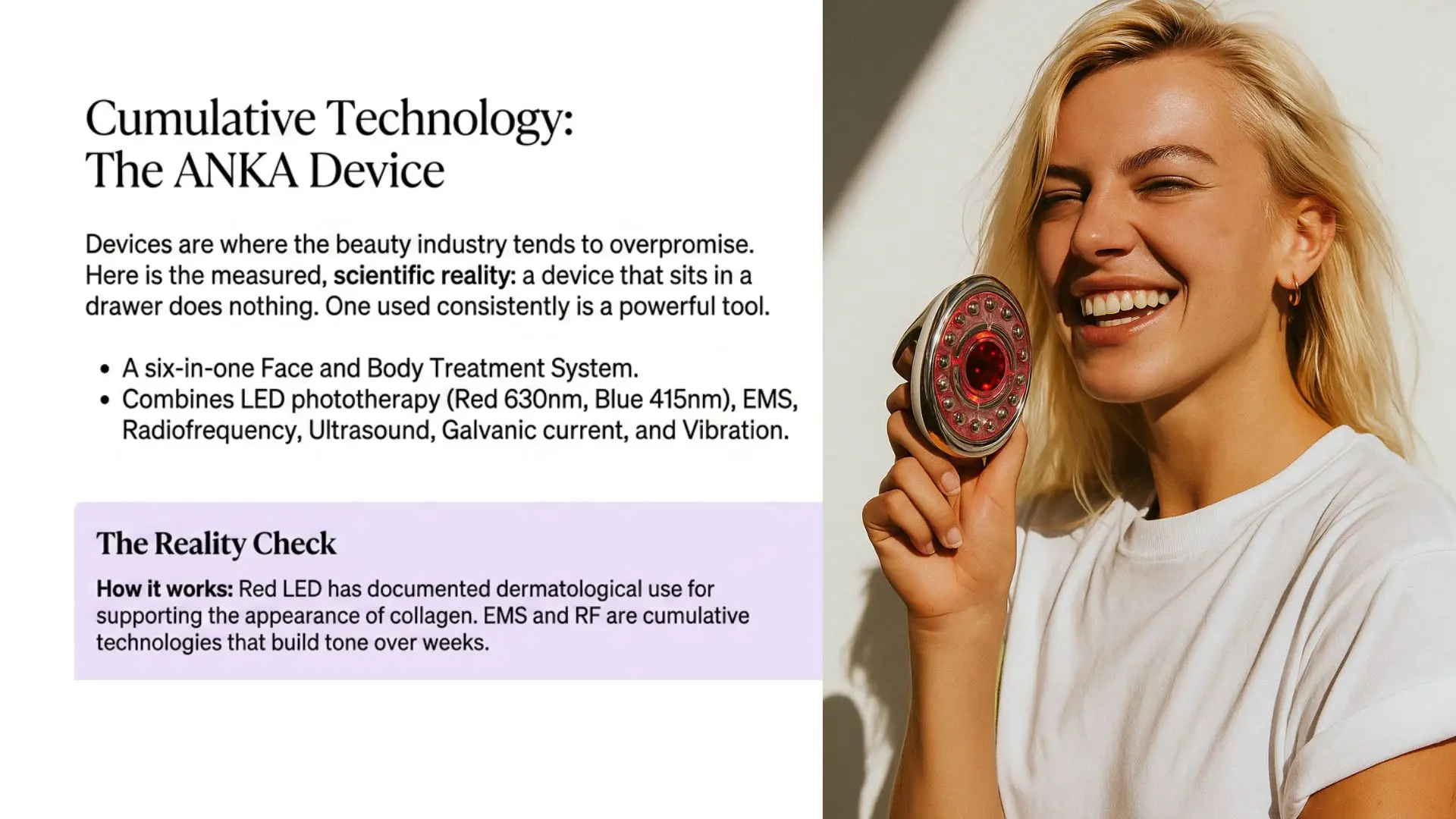
Used consistently, an LED and microcurrent device can support the appearance of firmness and tone across the face and body, which matters because weight-loss changes are not limited to the face. Cumulative technologies like EMS and radiofrequency work over weeks, not overnight. A device works best as part of a consistent routine, alongside daily barrier and collagen support.
Devices are where marketing tends to overpromise, so here is the measured version. The ANKA Face and Body Treatment System is a six-in-one device combining LED phototherapy (red at 630nm, blue at 415nm), EMS, radiofrequency, ultrasound, galvanic current, and vibration. Red LED phototherapy has documented dermatological use for supporting the appearance of firmness and collagen, and EMS and RF are cumulative technologies that work over weeks of consistent use, not overnight.
What that means for someone navigating GLP-1 skin changes: a device like ANKA can be a useful part of a consistent routine that supports the look of firmness and tone across both the face and the body. It works best alongside a barrier-first routine and, for pronounced concerns, professional guidance. A device that sits in a drawer does nothing. One you use several times a week, alongside a barrier-first routine, is where the value is.
A Realistic GLP-1 Skin Routine
Support the barrier, support collagen signaling, stay consistent. That is the whole strategy, and it is grounded in how skin actually adapts.
What to prioritize- ✓ Replenish lipids and hydration daily to protect a stressed barrier.
- ✓ Support visible collagen signaling with a topically studied peptide like Matrixyl.
- ✓ Calm the signs of inflammaging with skincare and life style changes rather than only chasing symptoms.
- ✓ If using a beauty device with LED light etc., use it consistently, several times a week, on face and body.
A barrier-first routine, in sizes you can start with.
Six sealed AveSeena travel sizes, including the Matrixyl Green Caviar Oil and the niacinamide Micro-Algae Serum, so you can begin supporting a stressed barrier before committing to full size.
Six formulas · $25.50 · 15% off your next full size
Meet the Six That Do the WorkWhy Does Weight Loss Affect How You Feel About Your Appearance?
Rapid weight loss is an emotional experience, not only a physical one. It can bring genuine relief and confidence, and it can also surface new insecurities as you adapt to a face and body that look different. A calm, sensory daily skincare ritual will not resolve that, but it can be a small, steady anchor you control while everything else shifts.
Changing quickly is not only a physical experience. Weight loss can bring real relief and confidence, and it can also surface new insecurities as you adapt to a face and body that look different. That is normal, and it is worth naming. A calm, sensory daily ritual, something that feels good and that you control, can be a small steady anchor while everything else shifts. Care for your skin gently, and give it time to catch up.
The Bottom Line
GLP-1 medications are changing many lives, and the skin changes that come with rapid weight loss are real, not vanity. The honest response is not a miracle cream or a device that promises to erase them. It is a barrier-first, evidence-led routine that supports collagen signaling, calms the inflammatory environment that accelerates aging, and stays consistent while the body settles. That is the approach AveSeena is built on.
The Bottom Line on GLP-1 and Your Skin
Rapid weight loss stresses the skin barrier and outpaces collagen. The right routine gives skin its best chance to adapt.
Prioritize the barrier, support collagen signaling with a topically studied peptide, calm inflammaging, and stay consistent, on both face and body. That is the evidence-led path, and it is the one AveSeena formulates for.
Frequently Asked Questions
What is "Ozempic face"?
It is the everyday name for the facial volume loss, hollowing, and skin laxity that can follow rapid weight loss on GLP-1 treatments. According to PubMed, facial volume loss and skin laxity are recognized esthetic consequences of GLP-1-induced weight loss (Haykal and colleagues, 2024).
How does skincare help skin during weight loss?
Skincare supports the skin as it adapts: it can visibly strengthen the barrier, support the look of collagen signaling, and improve the look of firmness and texture over time. The most reliable results come from a consistent routine used over weeks and months.
What ingredients thah can help skin during GLP-1 weight loss?
Focus on barrier support and collagen support: replenishing lipids, hydration, niacinamide, and a topically studied signal peptide such as Matrixyl. Consistency and mutlitasking formulas matter more than any single hero ingredient.
Does an LED device like ANKA help?
Used consistently, LED light and microcurrent beauty devices can support the appearance of firmness and tone, and cumulative technologies like EMS and RF work over weeks, not overnight. A device works fantastic in combination with your consistent daily routine.
Why do GLP-1 drugs come up so much with menopause?
As estrogen declines in perimenopause and menopause, fat storage shifts and the metabolic set point changes, so the same diet and exercise stop working. GLP-1 medications address appetite and metabolic regulation, which is part of why they come up so often in the menopause conversation. Decisions about any medication belong with your physician.
When should I start a skin routine during my GLP-1 journey?
Early and steadily. Because weight tends to stabilize around 8 to 12 months into treatment, ongoing barrier and collagen support throughout is more useful than waiting for a single dramatic intervention.
Scientific References (via PubMed):
1. Haykal D, Hersant B, Cartier H, Meningaud JP. The Role of GLP-1 Agonists in Esthetic Medicine: Exploring the Impact of Semaglutide on Body Contouring and Skin Health. J Cosmet Dermatol. 2025;24(2):e16716. doi:10.1111/jocd.16716
2. Garbaccio NC, et al. Plastic Surgery in the Ozempidemic: Considerations for the Timing of Body Contouring Surgery in Patients with Semaglutide-Associated Weight Loss. Aesthetic Plast Surg. 2025;49(21):6078-6088. doi:10.1007/s00266-025-05112-3
3. Karpuzoglu E. Inflammaging and skin. Front Immunol. 2025. doi:10.3389/fimmu.2025.1614841
4. Abdrabou Abouelmagd A, et al. Efficacy and safety of retatrutide, a novel GLP-1, GIP, and glucagon receptor agonist for obesity treatment: a systematic review and meta-analysis of randomized controlled trials. Proc (Bayl Univ Med Cent). 2025;38(3):291-303. doi:10.1080/08998280.2025.2456441
About the Author
Dr. Ebru Karpuzoglu, PhD is an immunologist, molecular medicine specialist, and the founder of AveSeena. Her peer-reviewed research on inflammaging, T cell biology, and endocrine-immune interactions is published in journals including Frontiers in Immunology. She formulates every AveSeena product based on three decades of laboratory and clinical research.
DISCLAIMER: This content, including any accompanying audio recording, is provided for general educational and informational purposes only. It does not constitute medical, health, or professional advice, and it is not a substitute for guidance from your physician or a qualified healthcare provider regarding GLP-1 medications, menopause, weight management, or any medical condition. Never disregard or delay seeking professional medical advice because of something you have read or heard here.
All information is drawn from openly available public sources, including peer-reviewed literature indexed on PubMed and cited in the article. Statements about specific medications describe published research and are not a recommendation to start, stop, or change any treatment. Any public figures referenced have discussed their own experiences in their own public statements; their mention is for illustration only and does not imply their endorsement of, or affiliation with, AveSeena or any product.
AveSeena skincare products and devices are cosmetic products intended to support the appearance of the skin. They are not intended to diagnose, treat, cure, or prevent any disease or medical condition, and they are not a treatment for weight loss or its medical effects. Individual results may vary. Consult a qualified professional for concerns specific to your skin, health, or medication.