Peptides in Skincare: What the Evidence Actually Supports
Peptides are on every label right now. An immunologist separates the ones with real published evidence from the ones that are mostly expensive filler.
Peptides are having a moment. They sound scientific, they carry a premium price, and the marketing around them promises collagen, firmness, and lines that soften on their own. Some of that is fair. Some of it is a story dressed up in a lab coat. The useful question is not whether peptides work in principle, because in the right formula they can, but whether a specific peptide, at a real concentration, has evidence behind it. That is the difference between an active and a filler.
Peptides have some of the better evidence among over-the-counter anti-aging ingredients, but the effect is supportive, not dramatic, and it depends entirely on the peptide and the formula around it. Signal peptides like Matrixyl (palmitoyl pentapeptide) are the most studied for the look of firmness and fine lines.
At AveSeena, peptides are used where they earn their place, alongside niacinamide and barrier lipids, in the Green Caviar Facial Oil Elixir and the Micro-Algae Immun B3 Serum.
What Peptides Actually Are
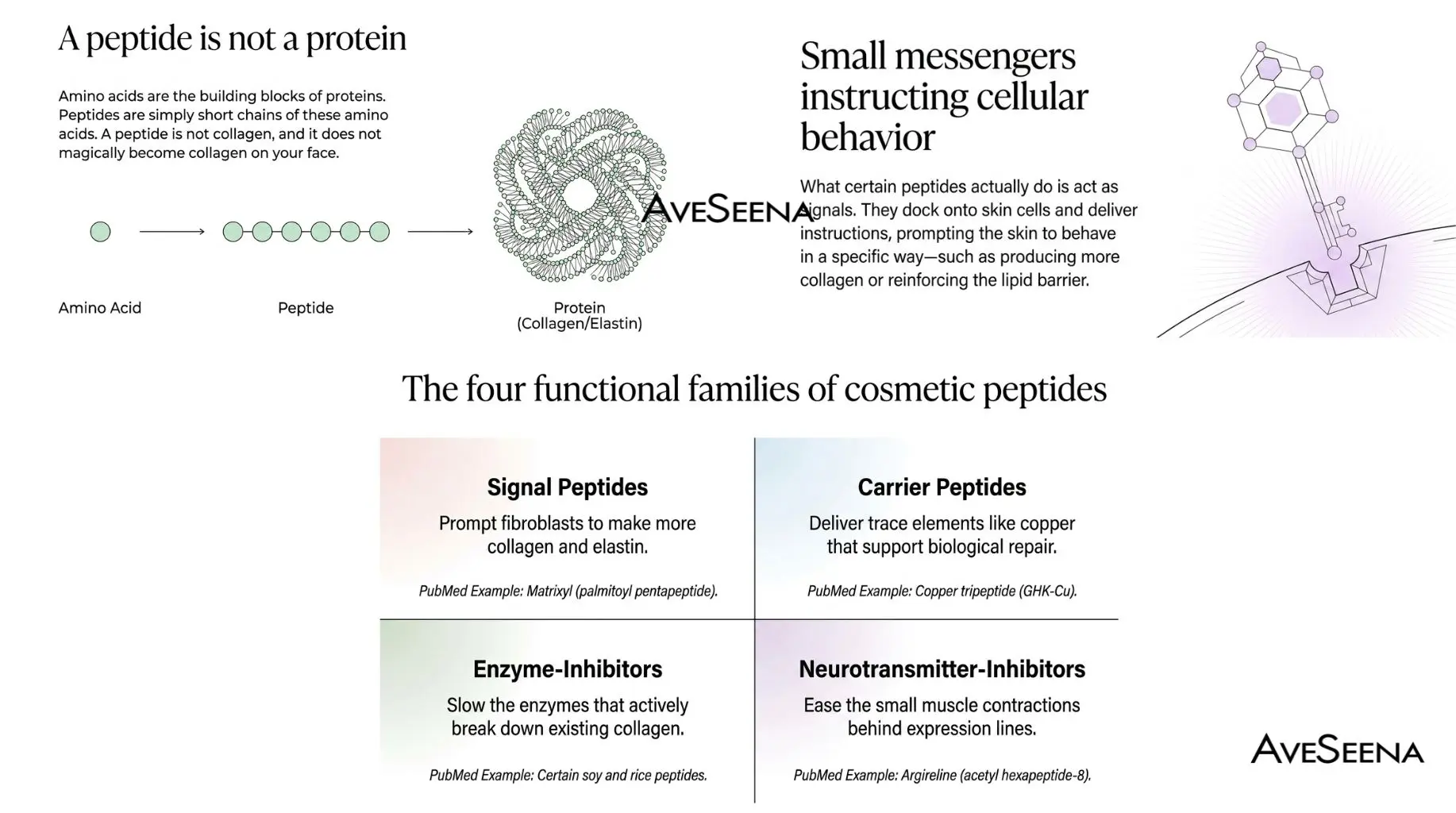
A peptide is a short chain of amino acids. Amino acids are the building blocks of the proteins your skin is made of, including collagen, elastin, and keratin. A peptide is not a protein and it does not become one on your face. What certain peptides can do is act as signals: small messengers that tell skin cells to behave in a particular way, such as producing more collagen or reinforcing the barrier.
That signaling idea is the whole reason peptides are interesting. But a signal only matters if the messenger reaches the cells that read it, and if there is enough of it to be heard. This is where the label and the formula matter more than the trend.
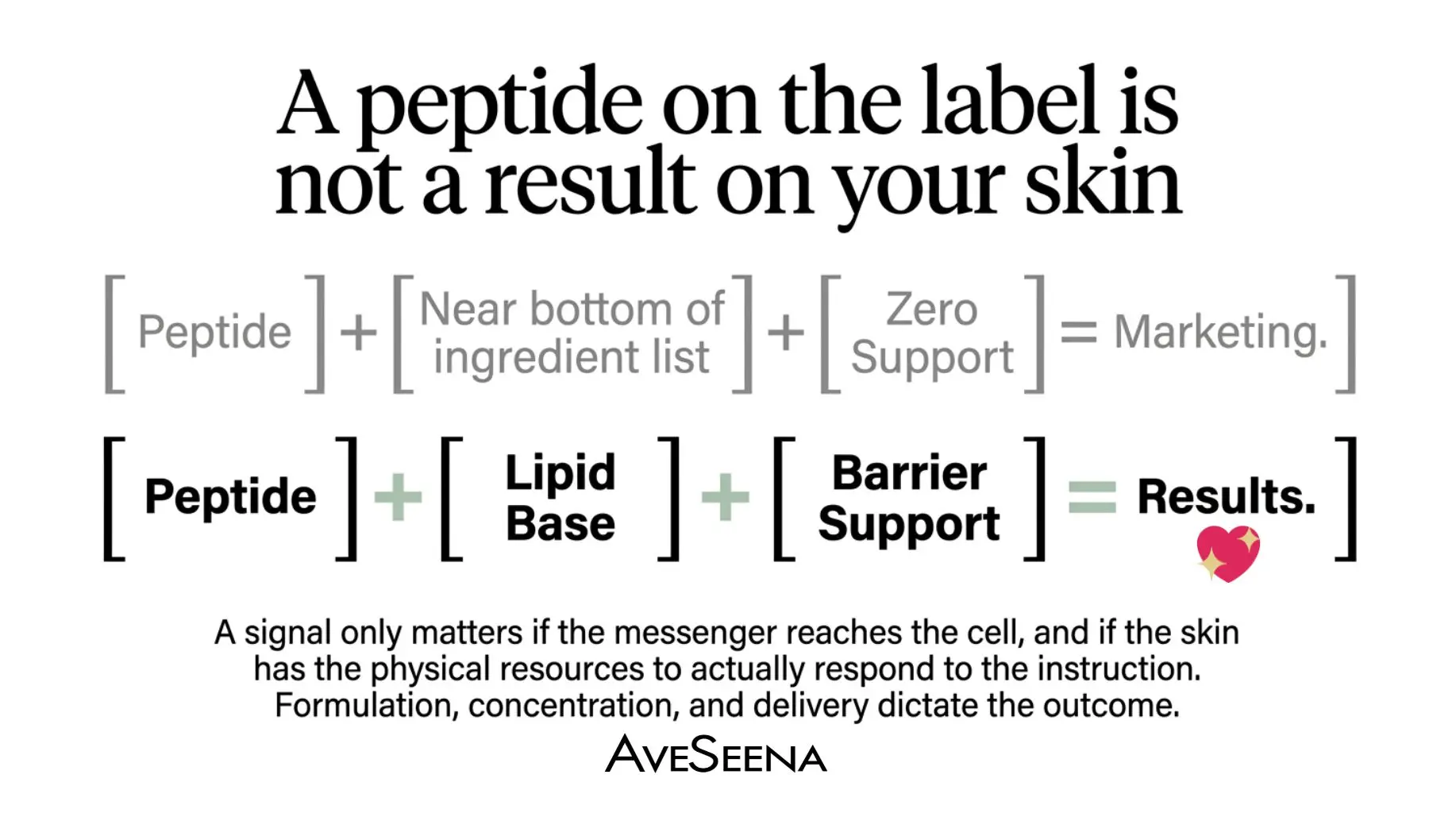
A peptide on the label is not a result on your skin. The question is which peptide, at what dose, in what formula.
The Four Families of Cosmetic Peptides
Based on articles retrieved from PubMed, cosmetic peptides are generally grouped into four functional families (Skibska and Perlikowska, 2021, DOI).
| Family | What it does | Common example |
|---|---|---|
| Signal peptides | Prompt fibroblasts to make more collagen and elastin | Matrixyl (palmitoyl pentapeptide) |
| Carrier peptides | Deliver trace elements like copper that support repair | Copper tripeptide (GHK-Cu) |
| Enzyme-inhibitor peptides | Slow the enzymes that break down collagen and elastin | Certain soy and rice peptides |
| Neurotransmitter-inhibitor peptides | Ease the small muscle contractions behind expression lines | Argireline (acetyl hexapeptide-8) |
Knowing the family tells you what a peptide is trying to do. It does not tell you how well it does it. For that you have to look at the studies.
What the Published Evidence Says
Here is the honest state of the science, drawn from peer-reviewed reviews rather than product pages.
Peptides rank well among over-the-counter actives, but the bar is modest. Based on articles retrieved from PubMed, a 2024 systematic review of cosmeceuticals for photoaging found that among the common categories studied, the evidence base behind peptides was the strongest, with most studies reaching a high level in the evidence hierarchy (Chan and colleagues, 2024, DOI). That is a genuine point in favor of peptides. It is also relative: over-the-counter anti-aging evidence overall is often thin, and topical tretinoin remains the clinical reference standard (Griffiths and colleagues, 2023, DOI).
Signal peptides are the workhorses. According to PubMed, signal peptides are the family most associated with prompting collagen and elastin production in topical use (Skibska and Perlikowska, 2021, DOI). Matrixyl belongs here. Its structure includes a fatty acid chain that helps it interact with the skin's lipid barrier, which is part of why it is one of the more credible topical peptides.
Argireline has real but limited trial data. The "Botox-like" nickname oversells it. Based on articles retrieved from PubMed, a randomized, placebo-controlled study in 60 subjects found acetyl hexapeptide-8 reduced the appearance of periorbital wrinkles versus placebo over four weeks, with roughly 49 percent subjective improvement (Wang and colleagues, 2013, DOI). That is one small, short study. It is not the same category of effect as an injectable, and it should not be described as if it were.
Peptides are best judged inside a whole formula. Based on articles retrieved from PubMed, systematic reviews of over-the-counter anti-aging agents repeatedly note that outcomes depend on formulation, concentration, and delivery, not the ingredient name alone (Imhof and Leuthard, 2020, DOI). A peptide listed near the bottom of an ingredient list, with no supporting actives, is closer to marketing than to a result.
The takeaway, in one line
Peptides are worth using, especially signal peptides, but as a supporting act in a well-built formula, not as a miracle on their own. Judge the peptide and the formula, not the buzzword.
- ✓ Signal peptides (Matrixyl): best evidence for the look of firmness and fine lines.
- ✓ Argireline: modest, short-term data for expression lines. Real, not dramatic.
- ✓ Concentration and formulation decide the outcome, not the label word "peptide."
How AveSeena Uses Peptides
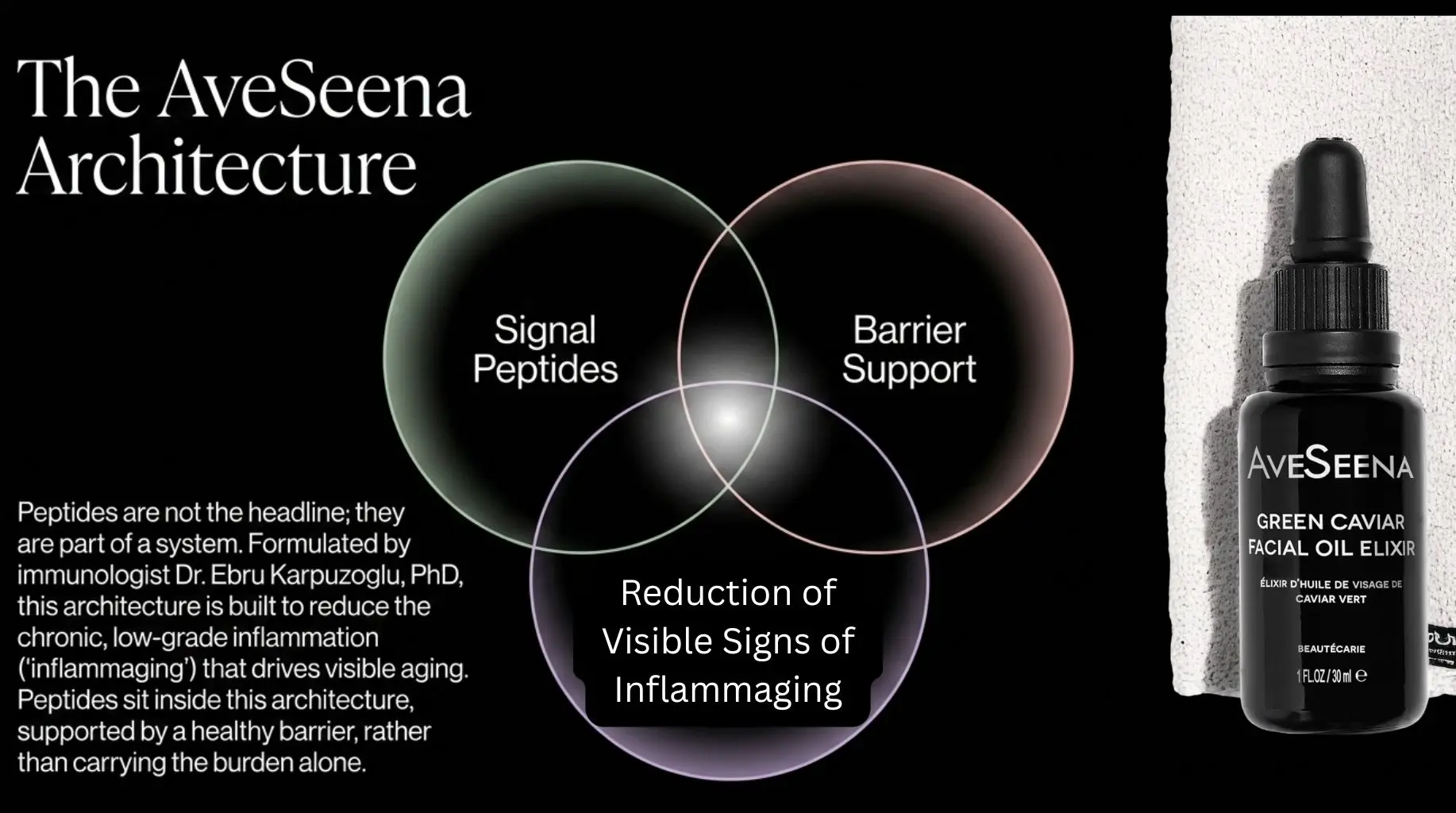
At AveSeena, peptides are not the headline. They are part of a system built around one idea: reduce the chronic, low-grade inflammation that drives visible aging, then support the barrier so skin can do its own repair. Peptides sit inside that architecture rather than carrying it alone.
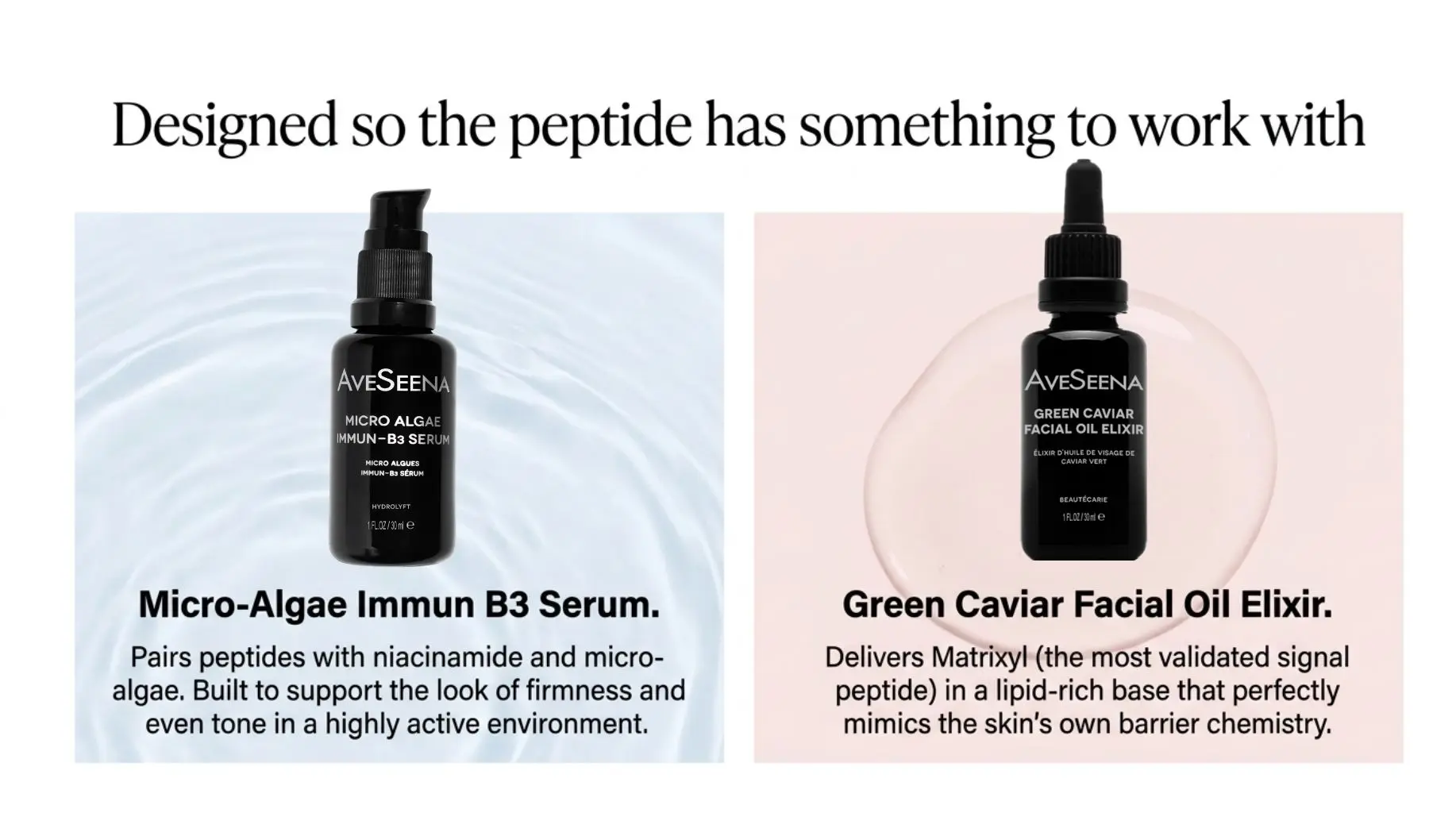
The Micro-Algae Immun B3 Serum pairs peptides with niacinamide and micro-algae to support the look of firmness and an even tone. The Green Caviar Facial Oil Elixir delivers Matrixyl in a lipid-rich base that works with the skin's own barrier chemistry. Both are designed so the peptide has something to work with, which is the entire point.
To understand why the barrier matters so much here, see our guide on how peptides strengthen the skin barrier and the science of inflammaging.
Test the formula on your own skin before you commit to full size.
Six sealed AveSeena travel sizes, including the Matrixyl Green Caviar Oil and the peptide-and-niacinamide Micro-Algae Serum, so you can judge how the formulas feel and perform before you buy a full bottle.
Six formulas · $25.50 · 15% off your next full size
Meet the Six That Do the WorkHow to Use Peptides in Your Routine
Peptides are easy to place and generally well tolerated.
- Morning: cleanser, then antioxidant serum, then a peptide moisturizer, then sunscreen.
- Evening: cleanser, then your retinoid if you use one, then a peptide cream to support and hydrate.
- Pair, do not stack blindly: peptides work well alongside niacinamide, barrier lipids, and daily SPF.
If your skin is reactive, patch test first. Peptides are usually gentle, but every formula is different, and the rest of the formula is what your skin actually meets.
The Bottom Line on Peptides
Peptides are not a gimmick, and they are not a miracle. They are a legitimate class of ingredients with some of the better evidence in the over-the-counter space, and their real value shows up when they are chosen deliberately and formulated with support. Do not buy the word on the label. Buy the formula that put the word there for a reason.
Frequently Asked Questions
Do peptides actually work in skincare?
Some do, in the right formula. Among over-the-counter anti-aging ingredients, peptides have some of the better published evidence, but the effect is supportive rather than dramatic, and it depends on the specific peptide, its concentration, and the formula around it. A peptide listed at the bottom of an ingredient list, with nothing to support it, is closer to marketing than to a result.
What do peptides do for your skin?
A peptide is a short chain of amino acids that can act as a signal to your skin cells. Certain peptides prompt fibroblasts to make more collagen and elastin, others help support the barrier or ease the small muscle movements behind expression lines. They do not become collagen themselves; they signal the cells that make it.
Is Argireline the same as Botox?
No. The nickname oversells it. Argireline (acetyl hexapeptide-8) has one small randomized, placebo-controlled study showing a modest reduction in the appearance of periorbital wrinkles over four weeks. That is real but limited data, and it is not the same category of effect as an injectable.
Which peptides does AveSeena use?
The Green Caviar Facial Oil Elixir is formulated with Matrixyl, a signal peptide, in a lipid-rich base. The Micro-Algae Immun B3 Serum pairs peptides with niacinamide and micro-algae. In both, the peptide sits inside a supporting formula rather than acting as a standalone hero, which is the point.
How do you use peptides in a routine?
Peptides are easy to place and generally well tolerated. In the morning, apply a peptide moisturizer after your antioxidant serum and before sunscreen. In the evening, apply a peptide cream after cleansing, or after your retinoid if you use one. Peptides pair well with niacinamide, barrier lipids, and daily SPF.
Are peptides safe for sensitive skin?
Peptides are usually gentle, which is part of why they are popular. That said, every formula is different, and the rest of the formula is what your skin actually meets. If your skin is reactive, patch test any new product first.
Scientific References (via PubMed):
1. Chan LKW, et al. Cosmeceuticals in photoaging: A review. Skin Res Technol. 2024;30(9):e13730. doi:10.1111/srt.13730
2. Skibska A, Perlikowska R. Signal Peptides, Promising Ingredients in Cosmetics. Curr Protein Pept Sci. 2021;22(10):716-728. doi:10.2174/1389203722666210812121129
3. Wang Y, et al. The anti-wrinkle efficacy of argireline, a synthetic hexapeptide, in Chinese subjects: a randomized, placebo-controlled study. Am J Clin Dermatol. 2013;14(2):147-153. doi:10.1007/s40257-013-0009-9
4. Griffiths TW, et al. Skin ageing and topical rejuvenation strategies. Br J Dermatol. 2023;189(Suppl 1):i17-i23. doi:10.1093/bjd/ljad282
5. Imhof L, Leuthard D. Topical Over-the-Counter Antiaging Agents: An Update and Systematic Review. Dermatology. 2020;237(2):217-229. doi:10.1159/000509296
This article is for educational purposes only and does not constitute medical advice. All information stated here is drawn from openly available web and public sources, including peer-reviewed literature indexed on PubMed and cited above. Individual results may vary. Consult a qualified professional for concerns specific to your skin or health.
About the Author
Dr. Ebru Karpuzoglu, PhD is an immunologist, molecular medicine specialist, and the founder of AveSeena. Her peer-reviewed research on inflammaging, T cell biology, and endocrine-immune interactions is published in journals including Frontiers in Immunology. She formulates every AveSeena product based on three decades of laboratory and clinical research.

Molecular Immunologist & Skincare Expert
As an Immunologist trained in Molecular Medicine and as an expert in skin care and cosmetic chemistry, Dr. Ebru Karpuzoglu has spent +20 years researching skin, impact of hormones on the immune system sharing her findings in international publications with her audience, and building an award-winning line of products. Trusted by scientists, doctors, editors, bloggers, celebrities and skincare lovers around the world, her deep real-world knowledge and research are invested in every drop of AveSeena.