Korean Ampoules and Essences: Science or Hype?
The K-beauty aisle has never been more crowded. Ampoules, essences, boosters, concentrates — at what point does a skincare routine stop helping your skin and start confusing it?
Let us start with what is actually happening. Korean beauty has introduced the Western world to an extraordinary idea: that skincare should be layered, intentional, and treated as a ritual rather than a chore. That idea is genuinely valuable. It changed how millions of people think about their skin.
But somewhere between the 7-step routine and the 12-step routine, something else happened. The market flooded with products that sound different but do suspiciously similar things. Ampoules. Essences. Serums. Boosters. Concentrates. The language kept multiplying, but the question nobody seemed to ask was: does your skin actually need all of this?
The honest answer is complicated.
What Is an Ampoule, Really?
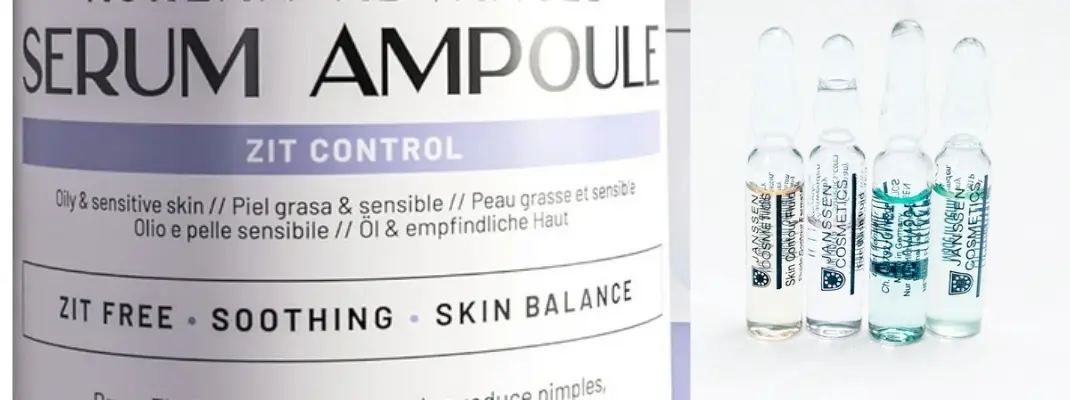
An ampoule is supposed to be a supercharged serum — a highly concentrated formula with more active ingredients per drop, designed for targeted treatment rather than daily maintenance. Think of it as the difference between a conditioner and a deep conditioning mask. Same family, different intensity.
Historically, ampoules were packaged in small sealed vials to keep ingredients stable until the moment they were opened. That packaging itself signaled potency — a single-use dose of something powerful enough to justify the sealed glass.
The problem is that today, the term has no regulation behind it. There is no governing body that decides what qualifies as an ampoule versus a serum versus a booster. Brands can call anything an ampoule. And many do. Some ampoules on the market are functionally identical to serums sitting on the same shelf. The label is different. The formula is not.
The Essence Question
Essences sit in the same gray area. In traditional Korean and Japanese skincare, an essence is a lightweight, water-based layer applied after cleansing to boost hydration before heavier products go on. It is the first "feed" of moisture — similar to a toner but usually more hydrating and less astringent.
When done right, this step genuinely improves how the rest of your routine performs. A well-hydrated skin surface absorbs subsequent products more effectively. The science is straightforward: hydrating ingredients like glycerin, hyaluronic acid, and niacinamide draw water into the upper layers of your skin and hold it there, creating a moisture reservoir that makes every layer you apply afterward work harder.
The issue is not with the concept. The issue is with multiplication. Do you need an essence and a serum and an ampoule and a booster? Or are you just applying four versions of the same thing in slightly different textures?
Serum vs. Ampoule vs. Essence
| Feature | Serum | Ampoule | Essence |
|---|---|---|---|
| Concentration | Moderate active concentration | Higher concentration of actives (in theory) | Lower concentration, lighter formula |
| Usage | Daily, morning and evening | Periodic intensive treatment | Daily, after cleansing |
| Texture | Gel, liquid, or lightweight cream | Ranges from watery to viscous | Watery to milky |
| Purpose | Deliver actives for daily maintenance | Target specific concerns intensively | Prep skin with hydration before heavier layers |
| Regulation | No formal definition | No formal definition — often identical to serums | No formal definition — overlaps with toners |
| Do You Need It? | Yes — this is the core active step | Only if your serum does not address a specific concern | Only if your serum is not hydrating enough on its own |
More products does not mean more results. More intention does.
When Too Much K-Beauty Is Too Much
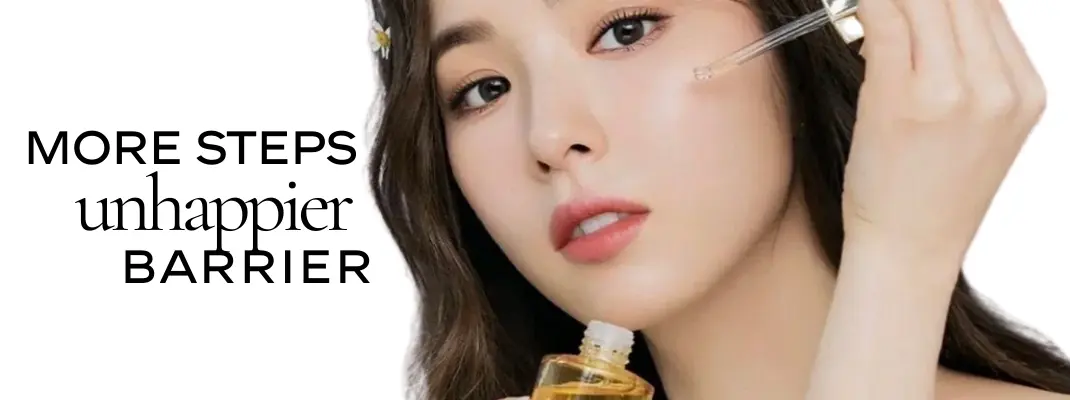
Here is what dermatologists and skin scientists will tell you that the K-beauty marketing machine will not: your skin barrier has a limit. It can only absorb so much at once. Piling on layer after layer of active ingredients does not double the benefit — it can actually overwhelm the barrier, increase sensitivity, trigger irritation, and accelerate the exact inflammation you are trying to prevent.
This is especially true when you are layering multiple products with overlapping ingredients. If your essence has niacinamide, your ampoule has niacinamide, and your serum has niacinamide, you are not getting three times the benefit. You are getting one dose of niacinamide and two extra opportunities for your skin to react to the preservatives, emulsifiers, and fragrance in the other two bottles.
There is a concept in immunology called the inflammaging threshold. Your skin tolerates a certain amount of environmental and chemical input before chronic low-grade inflammation kicks in. Every unnecessary product you layer — every extra fragrance, every redundant active, every additional preservative system — nudges you closer to that threshold. The irony is real: a routine designed to make your skin healthier can quietly push it toward the very inflammation that ages it.
The signs you are overdoing it
If your skin stings when you apply products that never used to sting, that is your barrier telling you something. If you are experiencing more redness, more sensitivity, more breakouts since adding steps to your routine — that is not purging. That is your skin asking you to stop. Dryness despite using five hydrating products is another signal. A compromised barrier cannot hold moisture regardless of how many layers you put on top. The solution is not another product. It is fewer products, better chosen.
Signs Your Routine Is Doing More Harm Than Good
| Symptom | What It Means |
|---|---|
| Stinging | Products you tolerated before now irritate — your barrier is compromised and permeability has increased |
| Persistent Redness | Chronic low-grade inflammation triggered by cumulative chemical exposure from multiple products |
| New Breakouts | Barrier disruption allows bacteria to penetrate more easily — often mistaken for "purging" |
| Dryness Despite Layering | A damaged barrier cannot retain moisture regardless of how many hydrating products you apply on top |
| Flaking or Peeling | Skin's outer protective layer is damaged from active ingredient overload — normal cell turnover is disrupted |
| Increased Sensitivity | Each additional product introduces preservatives, emulsifiers, and fragrances — cumulative exposure crosses the irritation threshold |
What Actually Works
The science is clear on what your skin needs for lasting hydration, barrier health, and protection against inflammaging. It needs three things, done consistently.
1. One well-formulated hydrating layer
Not three. One. A single serum or essence that delivers hydrating ingredients (glycerin, niacinamide, aloe vera) into the skin. It should absorb quickly, contain no unnecessary fragrance, and be formulated with ingredients chosen for their scientific benefit — not their trendiness. The Micro Algae Immun B3 Serum does this in one to two drops. Niacinamide, micro-algae extract, glycerin, Cica, aloe vera, bearberry, licorice root. Over 96% natural origin. No synthetic fragrance. One product. One step. Done.
2. One balanced moisturizer to seal
After hydration, you need a lipid seal — a cream or emulsion that locks moisture in and stops it from evaporating out. Not a thick, heavy cream that sits on top. A balanced blend of ceramides and emollients that reinforces the barrier without suffocating it. The Ageless Perfection Cream does exactly this. Seal the hydration, protect the barrier, move on with your day.
3. A clean start
None of this works if you are layering on top of a dirty or compromised surface. A gentle, non-stripping cleanser that respects your skin's pH and natural lipids is the foundation. The Gentle Gardenia Anti-Pollution Gel Cleanser removes impurities without disrupting the acid mantle — so everything you apply afterward actually gets where it needs to go.
Three products. Three steps. Cleanse, hydrate, seal. That is the entire ritual. It is rooted in the same Japanese philosophy that K-beauty borrowed its best idea from — the double-moisture method — but without the product multiplication that turned a beautiful concept into a 12-step obstacle course.
The Real Difference Between Hype and Science
Here is the simplest way to tell them apart.
Hype launches a new product category every season. PDRN ampoules. Exosome serums. Salmon DNA concentrates. Snail mucin boosters. Each one arrives with breathless marketing, viral TikTok momentum, and the implicit promise that this is the missing piece your routine has been waiting for. Then six months later, there is a new missing piece.
Science asks a different question: what does the skin actually need, and what is the most efficient way to deliver it?
The answer has not changed in decades. The skin needs hydration, protection (barrier support), and defense against the oxidative stress that accelerates visible aging (antioxidants, skin-calming botanicals). Every ingredient in a well-formulated routine should serve one of those three functions. If it does not, it is not helping. It is just sitting on your face.
Korean beauty deserves enormous credit for popularizing the idea that skincare is a ritual worth investing in. But the best version of that idea is not 12 products. It is the right products, chosen with intention, applied with consistency, and formulated by someone who understands the science of what skin actually needs — not what sells on social media.
Your skin does not need more products. It needs fewer products that do more.
The Bottom Line
Ampoules are not fake. Essences are not fake. The concept behind both — concentrated actives and layered hydration — is scientifically sound. What is fake is the idea that you need seven versions of the same step, each in a different bottle with a different name, to get results.
If you are going to use an ampoule, use it as what it was originally designed to be: an occasional intensive treatment for a specific concern. Not a daily staple stacked on top of three other serums. If you are going to use an essence, let it replace your toner — not add to it. And if your routine has more than five steps, ask yourself honestly: am I layering for my skin, or am I layering for the ritual?
There is nothing wrong with enjoying a ritual. But your skin does not care about aesthetics. It cares about barrier integrity, hydration balance, and inflammation. Give it those three things — cleanly, efficiently, consistently — and it will do the rest.
Less product. More intention. Better skin.
3-Step Science vs. 12-Step Trend
| Factor | 12-Step K-Beauty Routine | 3-Step Science Routine |
|---|---|---|
| Products Used | Oil cleanser, water cleanser, toner, essence, ampoule, serum, sheet mask, eye cream, moisturizer, sleeping mask, mist | Gentle cleanser, hydrating serum, balanced moisturizer |
| Preservative Exposure | 10–12 different preservative systems per routine | 3 preservative systems — minimal cumulative load |
| Fragrance Exposure | Multiple synthetic or natural fragrance sources | Synthetic fragrance-free formulations |
| Active Overlap | High — same ingredients (niacinamide, HA, glycerin) repeated across 4–6 products | None — each product serves a distinct function |
| Barrier Risk | Higher — cumulative chemical load can overwhelm the skin's protective barrier | Lower — fewer products, less disruption, stronger barrier |
| Time | 15–30 minutes | Under 5 minutes |
| Cost | $150–$400+ across all products | Streamlined investment in fewer, better formulations |
| Science Basis | Marketing-driven product multiplication | Barrier science: hydrate, seal, protect |
Three steps. No hype. Just science.
Your Questions, Answered
What is the difference between a serum and an ampoule?
A serum is designed for daily use — it delivers active ingredients at moderate concentrations as part of your regular routine. An ampoule is supposed to be a more concentrated, intensive treatment used periodically for specific skin concerns. Think of a serum as your daily conditioner and an ampoule as your deep conditioning mask. That said, there is no official regulation governing these terms, so many products marketed as ampoules are functionally identical to serums.
How often should you use an ampoule?
Because ampoules are more concentrated, they are best used as short-term intensive treatments rather than everyday staples. Two to three times per week, or during periods when your skin needs extra support (seasonal changes, post-travel, after sun exposure), is a reasonable approach. If you are using a well-formulated daily serum that already contains the right concentration of actives, you may not need a separate ampoule at all.
Do I need both an essence and a serum?
In most cases, no. An essence and a serum serve similar functions — delivering hydrating and active ingredients to the skin. If your serum is lightweight, fast-absorbing, and hydrating enough on its own, it already does what an essence does. Adding both is only justified if the two products contain meaningfully different ingredients that serve different functions. If they overlap, you are just doubling your exposure to preservatives and fillers for no additional skin benefit.
Can too many skincare products damage your skin?
Yes. Layering too many products can overwhelm the skin barrier, leading to increased sensitivity, redness, breakouts, and irritation. Every product you apply introduces its own preservative system, emulsifiers, and potential irritants. When multiple products contain overlapping active ingredients, you are also increasing your exposure to those actives beyond what your skin can productively use. A compromised barrier from over-layering actually accelerates inflammaging — the chronic low-grade inflammation that drives premature skin aging.
What is the simplest effective skincare routine?
Three steps: cleanse, hydrate, seal. A gentle cleanser that does not strip the barrier, a hydrating serum with skin-calming and brightening ingredients, and a balanced moisturizer that locks everything in. The AveSeena Gentle Gardenia Gel Cleanser, Micro Algae Immun B3 Serum, and Ageless Perfection Cream deliver this in three products formulated by a molecular immunologist to work together. No redundancy, no unnecessary steps, no hype ingredients.
References
1. Del Rosso JQ, Zeichner J, Alexis A, et al. Understanding the Epidermal Barrier in Healthy and Compromised Skin: Clinically Relevant Information for the Dermatology Practitioner. J Clin Aesthet Dermatol. 2016;9(4 Suppl 1):S2-S8. PubMed
2. Rosso JQ. Skin 101: Understanding the Fundamentals of Skin Barrier Physiology. J Clin Aesthet Dermatol. 2025;18(3):30-39. PMC
3. Yokota M, Maibach HI. Moisturizer effect on irritant dermatitis: an overview. Contact Dermatitis. 2006;55(2):65-72. PubMed
4. Lee E, An S, Choi D, et al. Comparison of objective and sensory skin irritations of several cosmetic preservatives. Contact Dermatitis. 2007;56(3):131-136. PubMed
5. Ma X, Wang H, Song Y, Pan Y. Skin irritation potential of cosmetic preservatives: An exposure-relevant study. J Cosmet Dermatol. 2021;20(1):195-203. PubMed
6. González-Muñoz P, Conde-Salazar L, Vañó-Galván S. Allergic contact dermatitis caused by cosmetic products. Actas Dermosifiliogr. 2014;105(9):822-832. PubMed
7. Uter W, Yazar K, Kratz EM, et al. Coupled exposure to ingredients of cosmetic products: II. Preservatives. Contact Dermatitis. 2014;70(4):219-226. PubMed
8. Deza G, Giménez-Arnau AM. Allergic contact dermatitis in preservatives: current standing and future options. Curr Opin Allergy Clin Immunol. 2017;17(4):263-268. PubMed
9. Boer M, Duchnik E, Maleszka R, Marchlewicz M. Structural and biophysical characteristics of human skin in maintaining proper epidermal barrier function. Postepy Dermatol Alergol. 2016;33(1):1-5. PubMed
10. Grubauer G, Feingold KR, Harris RM, Elias PM. Lipid content and lipid type as determinants of the epidermal permeability barrier. J Lipid Res. 1989;30(1):89-96. PubMed
11. Proksch E, Brandner JM, Jensen JM. The skin: an indispensable barrier. Exp Dermatol. 2008;17(12):1063-1072. PubMed
12. Imokawa G, et al. Ceramide lipids in water retention and barrier function of the stratum corneum. J Dermatol. 2022;49(7):615-625. PMC

Molecular Immunologist & Skincare Expert
As an Immunologist trained in Molecular Medicine and as an expert in skin care and cosmetic chemistry, Dr. Ebru Karpuzoglu has spent +20 years researching skin, impact of hormones on the immune system sharing her findings in international publications with her audience, and building an award-winning line of products. Trusted by scientists, doctors, editors, bloggers, celebrities and skincare lovers around the world, her deep real-world knowledge and research are invested in every drop of AveSeena.
Disclaimer: The content on this page is for educational and informational purposes only. It is not intended as medical advice and does not replace consultation with a qualified healthcare provider, dermatologist, or physician. While we present information to the best of our ability and reference peer-reviewed scientific literature, individual skin concerns, conditions, and responses to ingredients vary.