Why is the skincare industry having its worst year?
White-label deception. Sunscreens that failed lab tests. Celebrity brands collapsing. Customers used as beta testers. Four scandals. One category. One immunologist willing to name it.
Something has shifted in 2025 and 2026. The glossy product launches kept coming. The influencer unboxings kept stacking. Underneath the surface, four separate scandals rolled through the skincare industry within eighteen months, and most of them never reached the average shopper's feed.
Regulators in Australia pulled more than twenty sunscreens off shelves after independent lab testing showed they did not come close to their claimed SPF. A single contract manufacturer was traced to the base formula inside twenty-one different products. A brand openly marketed unfinished lab samples as a "live beauty trial" and asked customers to pay to participate. Celebrity lines that launched on name recognition alone went quiet, one after another, as clinical validation finally started to matter.
The formulation that skipped the trend cycle. You might want to see what it looks like.
See the Formula01 · What Is In The Bottle And What Is On The Label
In this case, label numbers and lab numbers rarely line up.
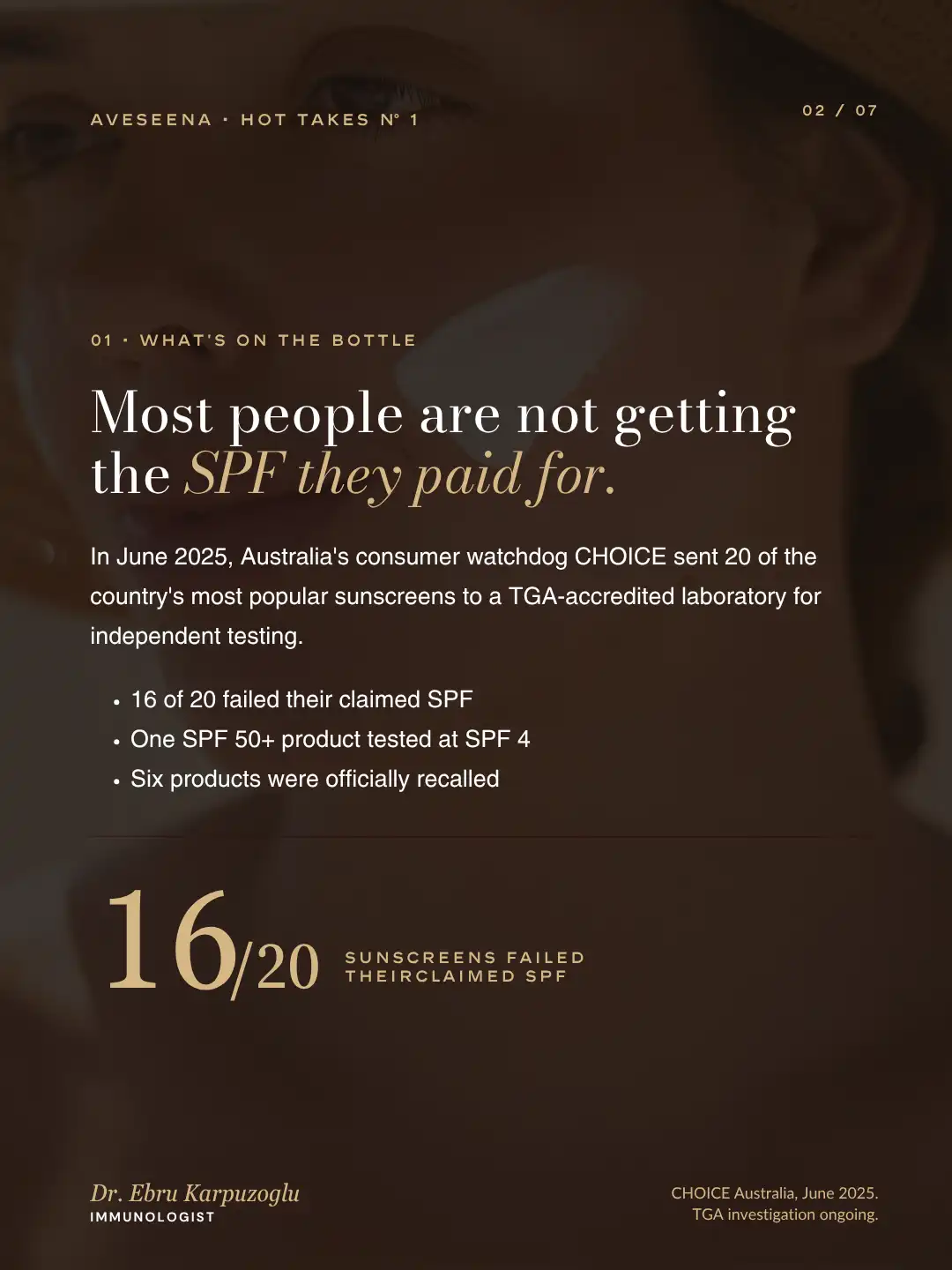
In June 2025, Australia's consumer advocacy group CHOICE sent twenty popular sunscreens to a TGA-accredited laboratory for independent testing. The goal was straightforward: verify whether each product delivered the SPF printed on its label.
Only four did. Sixteen failed. One product marketed as SPF 50+ returned an SPF of just 4, according to the CHOICE testing. Six sunscreens were pulled from the Australian market in the months that followed, and the Therapeutic Goods Administration opened a formal investigation.
This is not an Australia problem. It is a category problem. The CHOICE investigation simply happened to catch it, because Australia has one of the most rigorous sunscreen standards in the world and a consumer group willing to pay for independent lab testing. Most markets, including the U.S., do not.
The signal matters for anyone paying attention to signs of inflammaging. UV exposure is among the most studied accelerators of the inflammaging cascade, the low-grade inflammation that shows up as loss of tone, visible texture, and uneven pigment over time. A label that claims SPF 50+ and delivers SPF 4 is not a marketing inconvenience. It is a daily cumulative exposure gap.
02 · Who Actually Made It
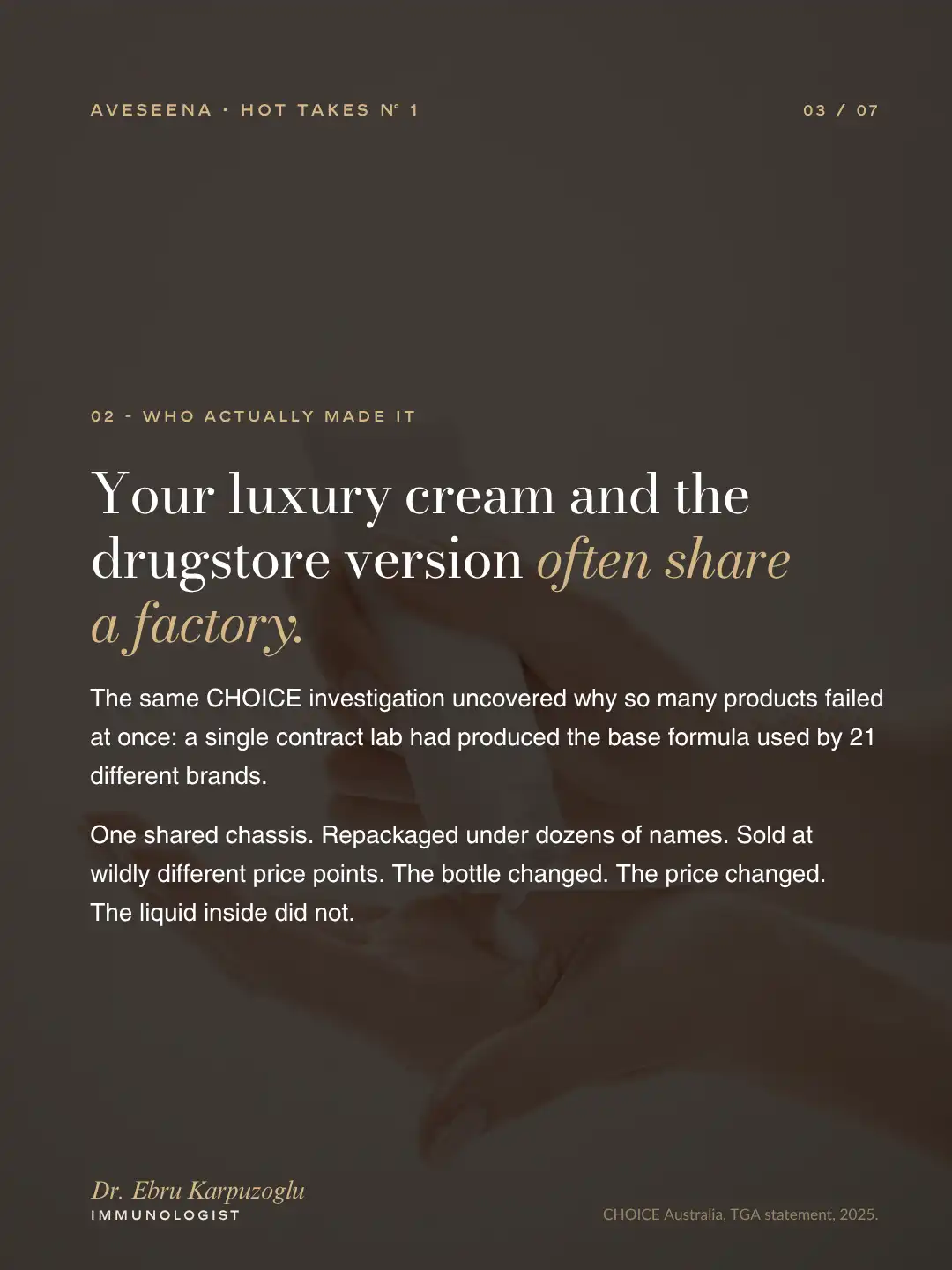
Different bottles, different prices, one shared chassis. What is this?
The follow-up to the CHOICE report made the deeper pattern clear. On September 30, 2025, the TGA confirmed that twenty-one separate sunscreens sold in Australia shared the same base formulation. The base was produced by a third-party manufacturer, Wild Child Laboratories, based in Western Australia. Preliminary testing indicated that the shared formula was unlikely to achieve SPF higher than 21, and in some cases tested as low as SPF 4.
Twenty-one products. One base. Different bottles. Different price points. Different brand stories. The liquid inside, broadly the same.
"The bottle changed. The price changed. The liquid inside did not."
What is white label deception today?Contract manufacturing is not, on its own, a scandal. It is how most of the cosmetics industry has always worked. The scandal is that it is rarely disclosed, and the pricing structure rarely reflects it. When an 18 dollar drugstore cream and a 180 dollar luxury cream come off the same production line, what the customer is paying for is the packaging, the marketing budget, and the story on the box.
03 · Why Be A Beta Tester With Your Own Money
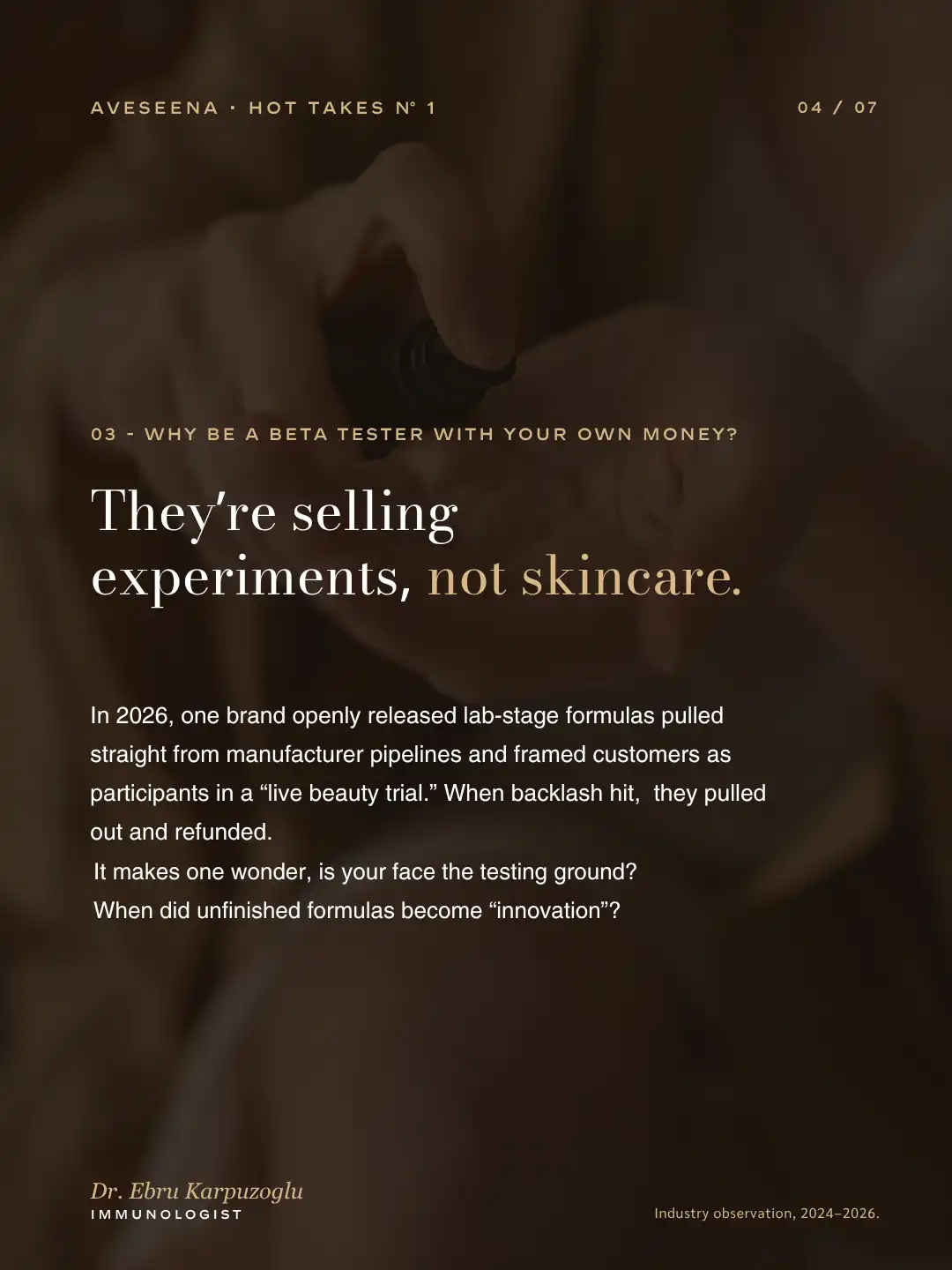
Unfinished formulas do not belong on your face.
In early 2026, one brand openly released lab-stage formulas pulled directly from manufacturer pipelines and framed customers as participants in what it called a "live beauty trial." The products were marketed as innovation. The framing was unfinished research, intentionally sold before completion, so that customer feedback could finish the formulation for free.
When the backlash hit, the brand pulled the line and issued refunds. The framing, however, is the point worth noticing. It is not an isolated stunt. It is a business model that has been quietly operating under softer language for years: limited drops, early-access launches, "iterative" product cycles that ship an unstable formula and adjust in version two.
The question is plain. When did unfinished formulas become innovation? And when did the final phase of product development, your face, start being treated like a free research input?
04 · When Names Stop Selling
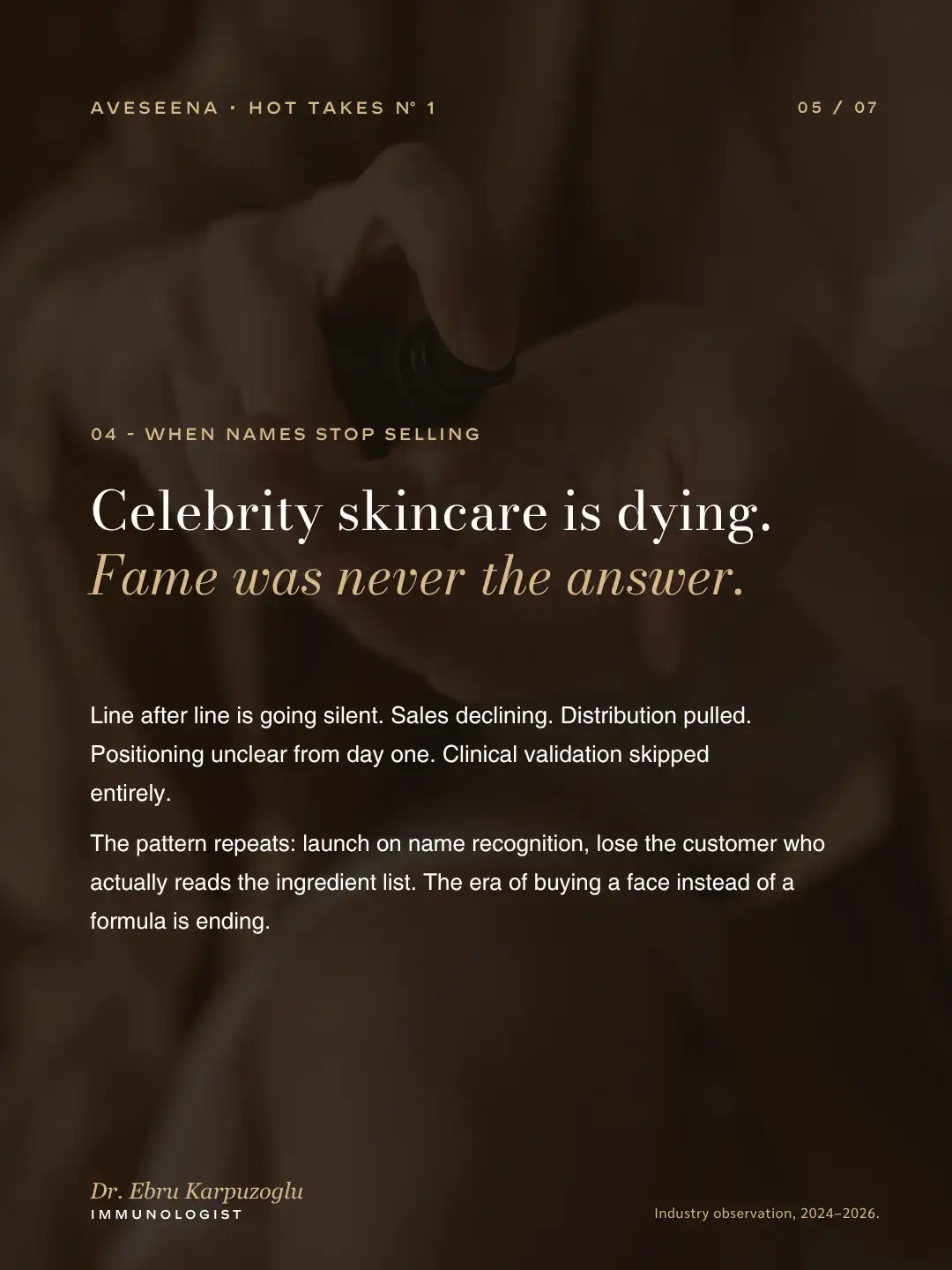
Celebrity sparkle and fame sell the first bottle. But what are you getting?
Line after line is going silent. Sales declining. Distribution pulled. Positioning unclear from day one. Clinical validation skipped entirely. The pattern repeats: launch on name recognition, lose the customer who actually reads the ingredient list.
The celebrity skincare boom of the last decade was built on a simple assumption: that customer attention is the scarce resource, and anyone who owns it owns a skincare brand. That assumption is breaking, for a reason the industry did not predict. The customer who came in through celebrity attention is not the same customer who stays. The one who stays reads the INCI, looks up the molecular weight, asks who formulated it and whether the data exists.
That customer has never been the core buyer of most celebrity lines. The era of buying a face instead of a formula is ending, not because fame stopped working on attention, but because attention stopped converting to repeat purchase once the pricing premium had to be justified by something other than a headshot.
"We've been tricked, so we're in an education era. We want to see facts and studies before we just go ahead and buy anything."
A 49-year-old content creator on Gen X's beauty needs · ELLE05 · What This Means For Your Skin
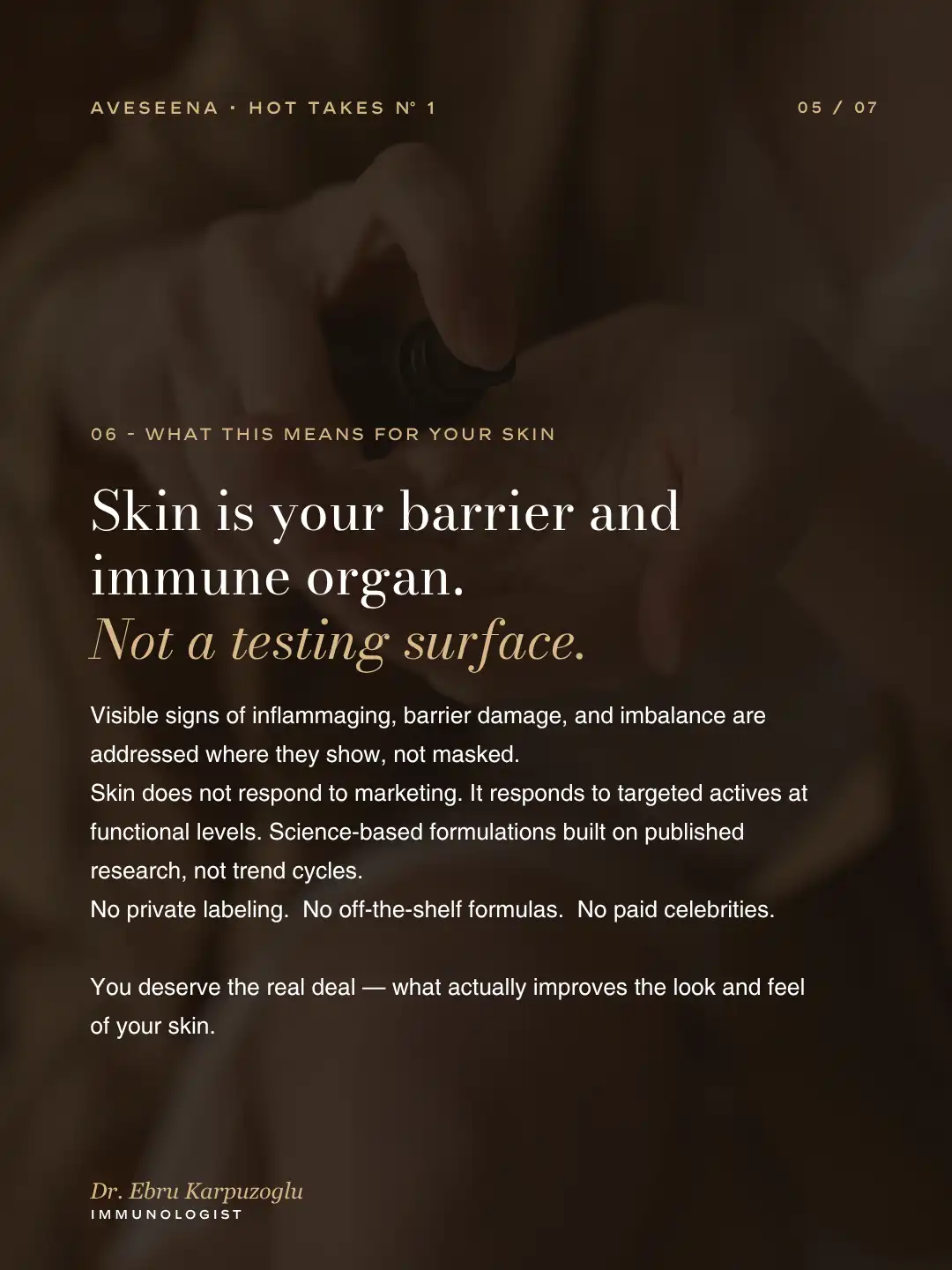
Skin is your barrier and immune organ. Not a testing surface.
Skin is not just a wrapper around your body. It is the biggest immune organ you have. Every second, it is deciding what to let in, what to block, and what to flag as a threat. When too many wrong things keep landing on it, a sunscreen that does not protect, a cream recycled from a generic base, an unfinished serum sold as innovation, the skin starts reacting. That quiet daily reaction is what eventually shows up on your face as dull, uneven, tired-looking skin.
What actually changes the way skin looks and feels is the opposite of a marketing story. It is the right actives at levels that function, inside formulas built on published research, not trend cycles. Signs of inflammaging, barrier stress, and imbalance are addressed where they show up. Not hidden under a veneer.
"Skin does not respond to marketing. It responds to targeted actives at functional levels."
06 · What AveSeena Does Differently
AveSeena exists as the counterweight to almost every pattern named above. No private labeling. No off-the-shelf formulas. No paid celebrities. Every formulation is developed directly by a molecular immunologist with published, peer-reviewed research on the inflammaging pathway.
For example, the Ageless Perfection Cream is built around a carefully selected stack of targeted actives chosen for their documented role in supporting the look of firmer, more even skin. It is not a reformulation of someone else's chassis. The formulation is original, and the reasoning behind every ingredient choice is traceable to the immunology literature.
The one to two drops, pressed in with the fingertips after cleansing, is a small daily act. What it is built on is the opposite of an experiment.
The formulation that never needed a celebrity to sell it. You might want to know what is in the bottle.
See What Is Inside Browse Full LineYour Questions, Answered
Why is the skincare industry having its worst year in 2025 and 2026?
Four separate scandals rolled through the category in eighteen months. Regulators in Australia pulled more than twenty sunscreens off shelves after independent lab testing showed they did not meet their claimed SPF. A single contract manufacturer was traced to the base formula inside twenty-one different products. A brand openly marketed unfinished lab samples as a "live beauty trial" and asked customers to pay to participate. Celebrity lines that launched on name recognition alone went quiet as clinical validation finally started to matter. The underlying signal across all four: shoppers have stopped accepting marketing as a substitute for evidence.
What was the CHOICE Australia sunscreen investigation?
In June 2025, Australia's consumer advocacy group CHOICE sent twenty popular sunscreens to a TGA-accredited laboratory for independent SPF testing. Sixteen failed their claimed SPF. One product marketed as SPF 50+ returned an SPF of just 4. The follow-up investigation, completed by the Therapeutic Goods Administration on September 30, 2025, identified twenty-one sunscreens sharing a single base formulation manufactured by Wild Child Laboratories in Western Australia. Preliminary testing indicated the shared formula was unlikely to achieve SPF higher than 21.
Why are so many sunscreens failing their SPF claims?
The CHOICE investigation traced most of the failures back to two factors: shared base formulations used across multiple brands, and reliance on a single offshore testing lab whose results were later flagged by the TGA as unreliable. Twenty-one sunscreens sold in Australia were found to share a single base formula that preliminary testing suggested was unlikely to achieve SPF higher than 21. The issue was not a single bad brand. It was a supply chain in which many brands outsourced both the formulation and the testing, and the results compounded.
What is white-label skincare and why does it matter?
White-label or private-label skincare means a contract manufacturer produces a generic base formula and multiple brands rebrand and resell it. The practice is legal and widespread. The reason it matters is pricing transparency. When a luxury cream and a drugstore cream share a factory and a base, the price difference reflects packaging and marketing, not formulation quality. A shopper paying a luxury price is often paying for the story, not the science.
What is the difference between white label and private label skincare?
The two terms are often used interchangeably, and in cosmetics they largely overlap. White label typically describes a pre-formulated product that a manufacturer sells to multiple brands, each of which simply adds its own label and packaging. Private label usually involves slightly more customization, such as fragrance adjustments, color changes, or minor ingredient tweaks, but the underlying base formula still comes from the manufacturer rather than the brand. Both are forms of contract manufacturing. Neither involves the brand developing the formula from scratch.
What does OEM mean in cosmetics manufacturing?
OEM stands for Original Equipment Manufacturer. In the cosmetics context, an OEM produces products to the specifications of the brand that commissions them, often starting from a stock base formula and modifying it. OEM is distinct from pure white labeling in that the brand may direct some aspects of the formulation, but it still differs from custom formulation where the brand owns the original research and development. The short version: OEM, white label, and private label all sit on a spectrum of outsourced manufacturing, with varying degrees of brand input.
When should you stop buying white-label skincare?
White-label skincare goes by several names: private label, OEM (original equipment manufacturer), and stock formula. All of them describe the same underlying pattern. A contract manufacturer produces a generic base, and multiple brands apply their own names, packaging, and pricing to it. The practice is legal. The moment it stops being a fair exchange is when the price reflects marketing and packaging rather than any original research or formulation investment. A practical signal: if the ingredient list is nearly identical to a much cheaper product, and the brand cannot point to its own formulation work, a named formulator, or publicly verifiable research, the premium is for the story, not the science. That is the point to walk away.
Is celebrity-backed skincare worth buying?
Celebrity endorsement is a marketing decision, not a formulation one. Some celebrity lines are formulated rigorously. Many are not. The useful filter is the same for any skincare purchase: who formulated it, what is their scientific background, has the formulation been tested against the claim, and is the data publicly verifiable. When those answers exist, the celebrity is incidental. When they do not, the celebrity is the product.
How can a shopper tell if a product is science-based or just marketed that way?
Three signals help separate the two. First, the person or team behind the formulation has a verifiable scientific background, not only a marketing title. Second, the ingredient list reflects targeted actives at functional concentrations, not a long list of filler. Third, the claims on the packaging describe appearance-level effects, not biological changes the product legally cannot promise. AveSeena's formulations are developed by a molecular immunologist with peer-reviewed research indexed on PubMed and published in Frontiers in Immunology.
What is inflammaging?
Inflammaging is a term coined in 2000 by researcher Claudio Franceschi to describe the chronic, low-grade, sterile inflammation that develops with age, in the absence of infection. It results from a loss of control over systemic inflammation and chronic overstimulation of the innate immune system. In the skin specifically, inflammaging contributes to the cutaneous changes associated with aging, such as loss of firmness, uneven tone, and visible texture changes. The 2023 review by Pająk and colleagues in the International Journal of Molecular Sciences summarizes the immunosenescence and inflammaging cascade in the skin.
What does "signs of inflammaging" mean in skincare?
In a skincare context, "signs of inflammaging" refers to the visible cutaneous outcomes of the inflammaging process: loss of firmness, uneven tone, visible texture changes, and a general tired appearance that reads as older than actual age. Cosmetic products cannot treat or reverse inflammaging as a biological process, but they can address the appearance of these signs through targeted actives that support skin comfort, barrier function, and visible resilience.
Does topical retinoid actually help with visible photoaging?
The published literature, including the 2024 review by Mambwe and colleagues in the International Journal of Cosmetic Science, supports the use of cosmetic retinoids for the appearance of photoaged skin through their effect on epidermal and dermal remodeling. The mechanism is well documented. The practical point is formulation: the retinoid form, concentration, and delivery system determine whether the mechanism reaches the skin or stays on the surface.
Last updated: April 2026
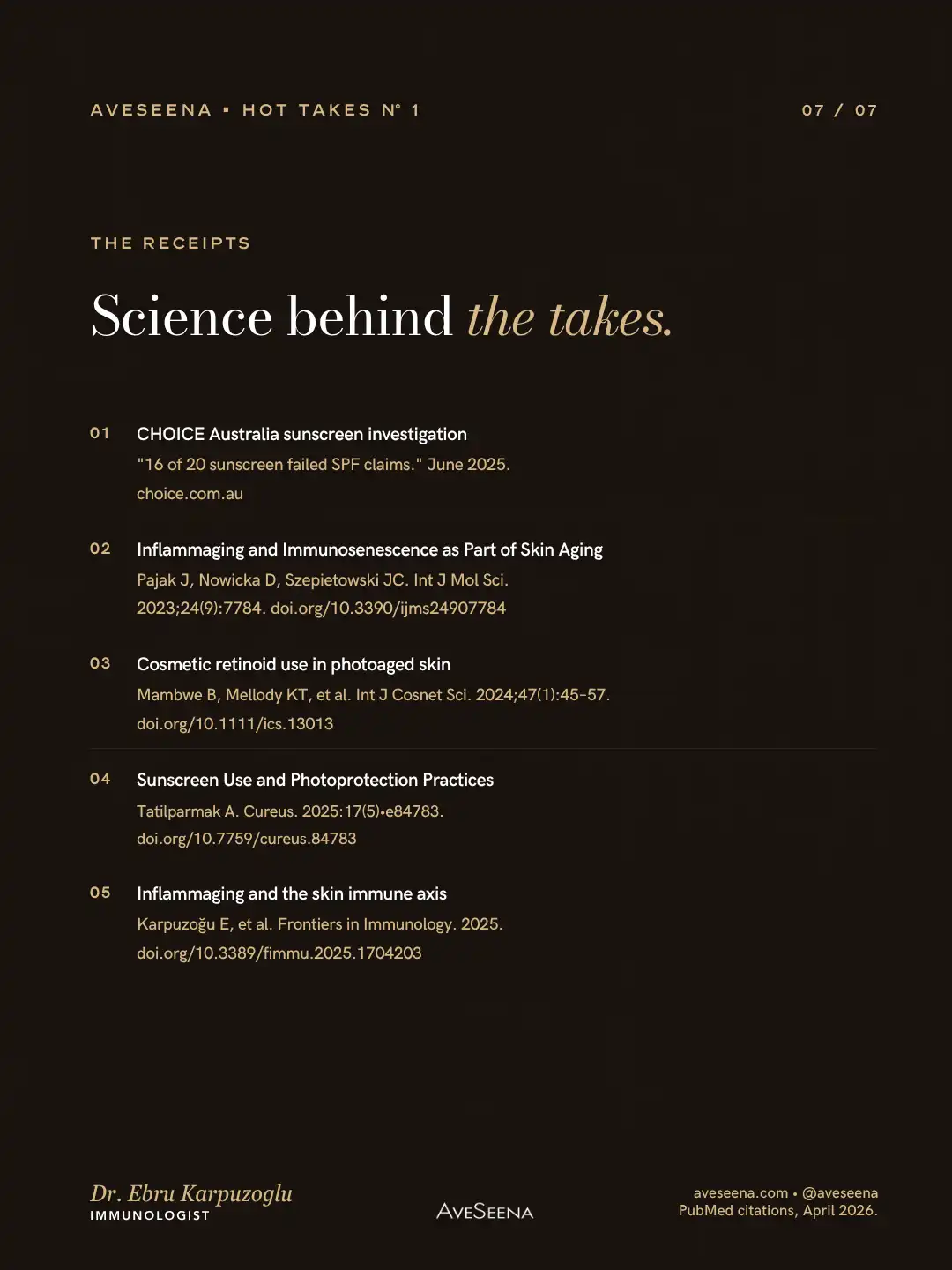
Scientific References
1. Pająk J, Nowicka D, Szepietowski JC. Inflammaging and Immunosenescence as Part of Skin Aging: A Narrative Review. Int J Mol Sci. 2023;24(9):7784. PubMed
2. Mambwe B, Mellody KT, Kiss O, O'Connor C, Bell M, Watson REB, Langton AK. Cosmetic retinoid use in photoaged skin: A review of the compounds, their use and mechanisms of action. Int J Cosmet Sci. 2025;47(1):45-57. PubMed
3. Tatliparmak A. Sunscreen Use and Photoprotection Practices: A Cross-Sectional Survey of Adults in a Dermatology Outpatient Clinic. Cureus. 2025;17(5):e84783. PMC
4. Karpuzoglu E, Holladay SD, Gogal RM Jr. Inflammaging: triggers, molecular mechanisms, immunological consequences, sex differences, and cutaneous manifestations. Front Immunol. 2025;16:1704203. PubMed | PMC
Sources
CHOICE Australia. "We tested the SPF claims of 20 sunscreens. 16 failed." CHOICE Product Testing, June 2025. Source
Therapeutic Goods Administration. "Sunscreen SPF testing: information for consumers." TGA News, September 2025. Source
CHOICE Australia. "TGA acts following CHOICE sunscreen investigation." CHOICE, September 30, 2025. Source
ELLE magazine. "Gen X Is Taking Over Beauty, and Brands Are Finally Catching Up." April 2026 issue. Source

Molecular Immunologist & Skincare Expert
As an Immunologist trained in Molecular Medicine and as an expert in skin care and cosmetic chemistry, Dr. Ebru Karpuzoglu has spent +20 years researching skin, impact of hormones on the immune system sharing her findings in international publications with her audience, and building an award-winning line of products. Trusted by scientists, doctors, editors, bloggers, celebrities and skincare lovers around the world, her deep real-world knowledge and research are invested in every drop of AveSeena.
Disclaimer: The content on this page is for educational and informational purposes only. It is not intended as medical advice and does not replace consultation with a qualified healthcare provider, dermatologist, or physician. Information is presented to the best of our ability and referenced to peer-reviewed scientific literature, but individual skin concerns, conditions, and responses to ingredients vary.
The quoted statement featured in this article was originally published in ELLE magazine’s April 2026 issue (“Gen X Is Taking Over Beauty, and Brands Are Finally Catching Up”). It is reproduced here for editorial and informational purposes only and remains the intellectual property of Hearst Magazine Media, Inc.