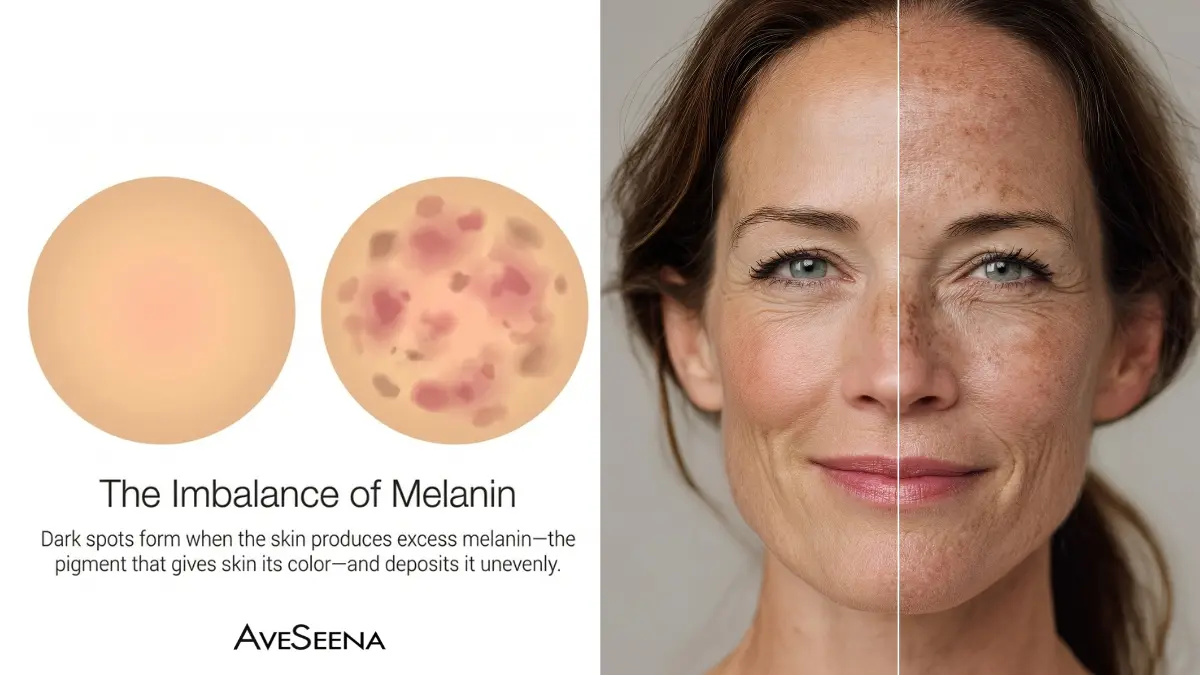
What causes hyperpigmentation and uneven tone? Dark spots form when the skin produces excess melanin — the pigment that gives skin its color — and it deposits unevenly. The three main triggers are UV radiation, post-inflammatory response, and hormonal fluctuations. Understanding which type is behind the look of your dark spots is the first step toward visibly addressing them and how you can use your skincare regimen against hyperpigmentation gives you the superpower your skin needs.

How Dark Spots Actually Form
Your skin gets its color from a pigment called melanin. Special skin cells called melanocytes produce it. Think of them like tiny paint factories sitting at the base of your skin.
These factories use a switch called tyrosinase. When tyrosinase gets activated, it starts making melanin. That melanin gets delivered into the upper layers of your skin, spreading out to create your natural skin tone.
When everything works normally, melanin spreads evenly. But when melanocytes get over-stimulated, they make too much. It piles up in certain spots instead of spreading out. That is what creates the visible look of dark spots, uneven patches, or a blotchy complexion.

Cause 1: Sun Damage
Sun damage is the most common reason dark spots form.
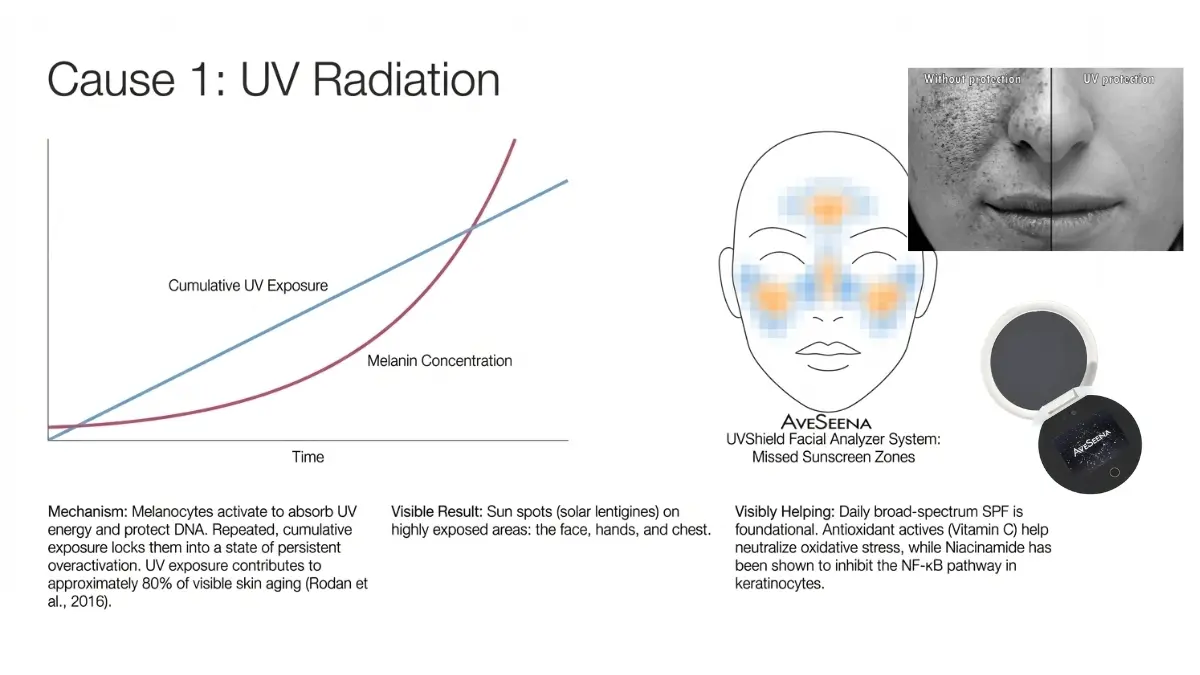
When UV rays from the sun hit your skin, your melanocytes switch on to protect you. Melanin absorbs UV energy and converts it to heat. This helps protect your skin cells from damage. That is actually a good thing in the short term.
The problem is repeated sun exposure. Over time, melanocytes stay switched on permanently. Melanin stops spreading evenly and starts pooling in specific spots. These are called sun spots. They tend to show up on your face, hands, shoulders, and chest, anywhere that gets a lot of sun.
Research shows that sun exposure is responsible for about 80% of the visible signs of skin aging, including dark spots, fine lines, and loss of firmness (Rodan et al., 2016).
There is another layer to this. Sun exposure also triggers inflammation inside the skin. That inflammation sends signals telling melanocytes to produce even more melanin (Chaiprasongsuk et al., 2022). This is part of what we call the visible signs of inflammaging: the slow, low-grade inflammation that quietly speeds up how your skin ages and contributes to the look of dark spots over time.
What may help visibly: Daily broad-spectrum SPF is the most important step, full stop. Vitamin C is an antioxidant that helps neutralize the damage UV causes. Niacinamide (Vitamin B3) has been shown to help calm the inflammatory signals that drive uneven tone (Moon et al., 2003).
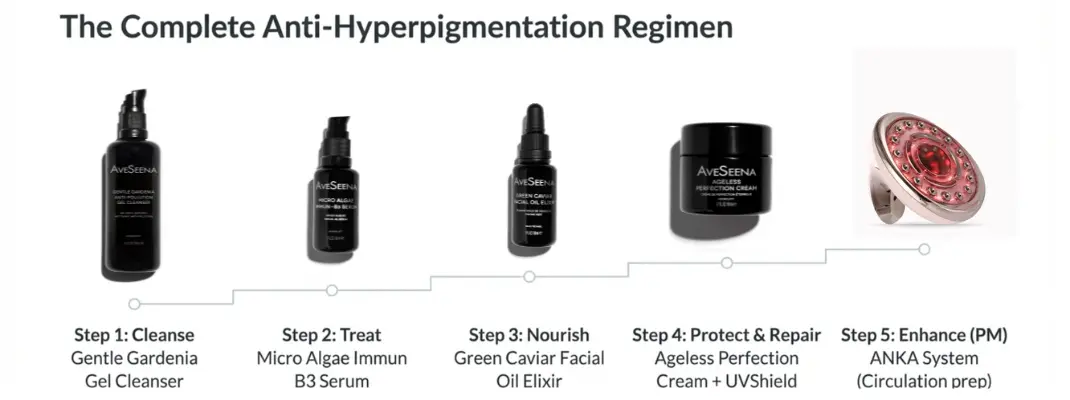
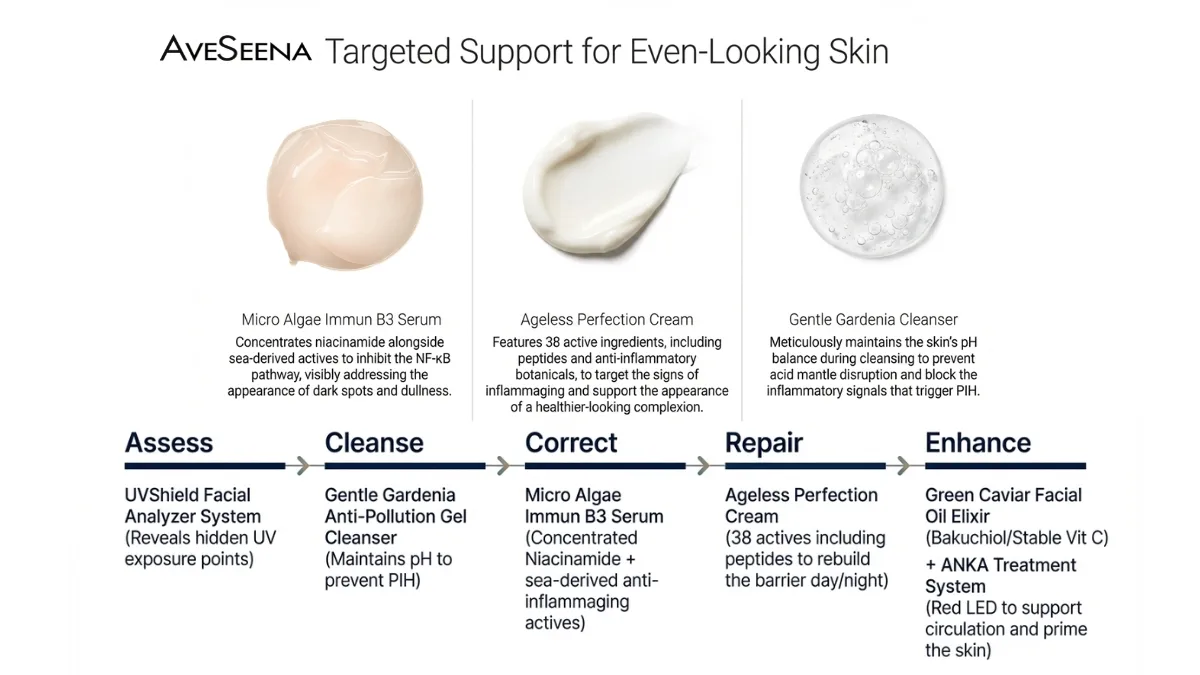
The UVShield Facial Analyzer System shows you exactly where UV is reaching your skin. It also reveals where your sunscreen has worn off or where you missed a spot when applying. A simple and practical tool for anyone trying to visibly reduce the look of sun-caused dark spots.
The Micro Algae Immun B3 Serum delivers a concentrated dose of niacinamide alongside sea-derived actives to help visibly address the appearance of dark spots and uneven tone linked to the visible signs of inflammaging.
Cause 2: Dark Marks from Breakouts and Skin Irritation
This type is called post-inflammatory hyperpigmentation, or PIH. It is one of the most common reasons people are left with dark marks after a breakout.
Here is what happens. Your skin gets inflamed from a pimple, eczema, a rash, or even a skincare product that was too strong. While your skin is healing, it sends out chemical signals to protect itself. Those signals accidentally tell the melanin factories nearby to produce more melanin. Extra melanin builds up in and around the inflamed area. When the inflammation settles, the dark mark stays (Yuan and Jin, 2018; Fu et al., 2020).
This is why post-acne dark marks are not really scars. The skin texture is usually fine. The pigment is what changed.
PIH tends to be more noticeable in medium to darker skin tones because those skin types have more active melanocytes that respond more strongly to inflammation.
One important thing to know: using harsh products to try to fix PIH can actually make it worse. Strong acids and retinoids can irritate the skin. That irritation is itself an inflammatory event. Which can trigger more melanin production. Slow and gentle is the right approach here.
What may help visibly: Start with calming, anti-inflammatory actives. Niacinamide works in two ways. It helps quiet the inflammatory signals that trigger melanin overproduction. It also slows down how much melanin gets transferred into the surface skin cells (Hakozaki et al., 2002). Once inflammation has calmed, you can gently support skin cell renewal over time.
The Ageless Perfection Cream contains 38 active ingredients chosen to help visibly address the signs of inflammaging: the slow, low-grade inflammation that drives the look of premature aging and uneven skin tone. It includes niacinamide (Vitamin B3), peptides, and calming botanicals to help support the look of a more even, healthier-looking complexion day and night.
The Gentle Gardenia Anti-Pollution Gel Cleanser keeps your skin’s natural pH balance intact while cleansing. This matters when your skin is already irritated or prone to dark marks. A cleanser that is too harsh can trigger inflammation and add to the appearance of PIH over time.
Cause 3: Hormonal Changes During Perimenopause and Menopause
Hormonal shifts are a real driver of dark spots that does not get talked about enough. For many women, the most significant period is perimenopause and menopause, when estrogen and progesterone levels start changing significantly.
Here is the connection.
Melanocytes have tiny receptors on their surface that pick up estrogen signals. When estrogen is stable, it helps keep melanin production balanced and even. But during perimenopause, estrogen does not just gradually decrease. It swings up and down unpredictably from month to month.
Those erratic signals confuse melanocytes. They can start overproducing melanin and distributing it unevenly. Research confirms that estrogen can directly switch on the genes inside melanocytes that control melanin production (Verdier-Sevrain et al., 2006; Jang et al., 2010).
Progesterone drops during this time too. That shift also affects how melanin is produced and distributed across the skin surface.
The skin itself also changes during perimenopause and menopause. It gets thinner. Skin cells turn over more slowly. Pigmented cells stick around on the surface longer than they used to. The skin also becomes more sensitive to sun damage, which compounds the appearance of uneven tone.
Studies suggest that up to 70% of perimenopausal women notice some form of visible hyperpigmentation.
Hormonal dark spots usually show up as patchy, symmetrical areas on the cheeks, forehead, upper lip, and nose. They can also appear on the forearms, neck, and chest later in menopause.
Daily SPF is essential alongside with best quality skincare approach here. Sun exposure re-stimulates melanocytes every single day. Without sunscreen, no topical skincare can visibly improve the look of hormonal hyperpigmentation.
What helps visibly: A combination of ingredients that target multiple steps in the melanin process works better than a single ingredient alone like niacinamide, vitamin C, Licorice extract etc
Niacinamide is a particularly good fit for perimenopausal and menopausal skin. It calms inflammation, slows melanin transfer, and supports the skin barrier at the same time. This matters because skin at this stage is more reactive and more sensitive to strong actives.
The Micro Algae Immun B3 Serum delivers niacinamide alongside sea-derived actives to help visibly address the appearance of dark spots and uneven tone. Fragrance-free and suitable for sensitive skin.
The Ageless Perfection Cream helps visibly support the skin barrier and address the signs of inflammaging that often become more visible during hormonal transitions. Its 38 active ingredients include peptides, niacinamide, and anti-inflammatory botanicals to help the skin look more even, firmer, and more radiant day and night.
The Bigger Picture: Signs of Inflammaging Connects All Three
There is one thread running through all three causes: inflammaging.
Sun damage triggers micro level inflammation (inflammaging) inside the skin. Breakouts and skin reactions are also classified as inflammation. Hormonal shifts make the skin more sensitive to inflammation and inflammaging. In all three cases, that inflammation and inflammaging activate the same internal signals telling melanocytes to produce more melanin than the skin needs.
This is what the visible signs of inflammaging are: the slow, ongoing inflammation that quietly drives visible premature skin aging, dark spots, and loss of radiance at the same time. Managing it is a more complete approach than just layering brightening products on top of the problem.
The Green Caviar Facial Oil Elixir contains Bakuchiol (a gentler botanical alternative to retinol), stable Vitamin C, and squalane. It helps visibly support the skin barrier and may help address the look of uneven tone linked to the signs of inflammaging.
The ANKA Face and Body Treatment System combines six technologies in one device: Red, Blue, and Pink LED light, EMS, Ultrasound, and RF. Red LED light therapy supports the look of a refreshed, more even complexion. Used before your evening skincare routine, it helps prime the skin so actives can be more effectively absorbed. The result is a visibly lifted, more even-looking complexion.
What Causes Hyperpigmentation: Quick Facts
- Root cause: Too much melanin building up unevenly in the skin
- 3 main triggers: Sun damage, skin inflammation (breakouts, rashes), hormonal changes
- UV contribution to visible aging: ~80% of dark spots, fine lines, and loss of firmness (Rodan et al., 2016)
- Why breakouts leave dark marks: Inflammation triggers melanin overproduction during healing — this is post-inflammatory hyperpigmentation (PIH)
- PIH most common in: Medium to deeper skin tones (Fitzpatrick III-VI)
- Hormonal dark spots: Estrogen and progesterone shifts during perimenopause and menopause disrupt melanocyte activity
- Perimenopausal women affected: Up to 70% experience some visible hyperpigmentation
- Signs of inflammaging link: The same slow inflammation that ages skin also overactivates melanocytes
- Key ingredient for all 3 types: Niacinamide (Vitamin B3) — calms inflammation, slows melanin transfer, supports skin barrier
- Non-negotiable for any type: Daily broad-spectrum SPF 30+ — UV re-triggers melanocytes every day
Frequently Asked Questions
What causes hyperpigmentation? Too much melanin building up unevenly. The three main triggers are sun exposure, skin inflammation, and hormonal changes.
Can the appearance of dark spots fade on their own? Post-acne dark marks in lighter skin tones may visibly fade in 3 to 6 months. Sun spots and hormonal dark spots generally do not improve without consistent skincare and daily SPF.
Is a dark mark the same as a scar? No. A dark mark is a pigment change with no texture difference. A scar involves a physical change to the deeper skin layer. Both can happen after acne, which is why people mix them up.
Why do dark spots look worse in summer? More sun means more melanin gets triggered. Existing spots can look darker. Daily SPF is essential.
What is the connection between inflammation and dark spots? Inflammation sends internal signals that tell melanocytes to overproduce melanin. Calming that inflammation with actives like niacinamide helps visibly address both the appearance of dark spots and the signs of inflammaging.

Molecular Immunologist & Skincare Expert
As an Immunologist trained in Molecular Medicine and as an expert in skin care and cosmetic chemistry, Dr. Ebru Karpuzoglu has spent +20 years researching skin, impact of hormones on the immune system sharing her findings in international publications with her audience, and building an award-winning line of products. Trusted by scientists, doctors, editors, bloggers, celebrities and skincare lovers around the world, her deep real-world knowledge and research are invested in every drop of AveSeena.
Scientific References
-
Rodan K, Fields K, Majewski G, Falla T. Skincare bootcamp: the evolving role of skincare. Plastic and Reconstructive Surgery - Global Open. 2016;4(12 Suppl):e1152. doi:10.1097/GOX.0000000000001152. PMC5172479.
Used for: UV exposure accounts for approximately 80% of the visible signs of skin aging including dark spots, fine lines, and loss of elasticity. -
Chaiprasongsuk A, Janjetovic Z, Kim TK, et al. Role of phytochemicals in skin photoprotection via regulation of Nrf2. Frontiers in Pharmacology. 2022;13:823881. doi:10.3389/fphar.2022.823881.
Used for: UV-induced reactive oxygen species activate inflammatory signaling in keratinocytes and melanocytes, upregulating melanogenesis-related genes MITF, TYR, TRP-1, and TRP-2; the same pathway drives collagen degradation through MMP upregulation. -
Moon KY, Ahn KS, Lee J, Kim YS. Downregulation of NF-kappaB activation in human keratinocytes by melanogenic inhibitors. Journal of Pharmacological Sciences. 2003;92(1). PMID: 12727023.
Used for: Niacinamide was found to downregulate UV-induced inflammatory signaling in keratinocytes, supporting its role in visibly addressing uneven tone driven by UV and inflammation. -
Yuan XH, Jin ZH. Paracrine regulation of melanogenesis. British Journal of Dermatology. 2018;178(3):632-639. doi:10.1111/bjd.15651.
Used for: Inflammatory chemicals produced during breakouts and skin irritation directly stimulate melanocyte activity near the inflamed area, forming the basis for post-inflammatory dark marks. -
Fu C, Luo Y, Fu P, et al. Roles of inflammation factors in melanogenesis (Review). Molecular Medicine Reports. 2020;21(3):1421-1430. doi:10.3892/mmr.2020.10950. PMC7002987.
Used for: Review confirming that multiple inflammatory mediators produced by skin cells directly stimulate melanin production; mechanistic basis for why inflammation from breakouts and skin irritation leaves dark marks. -
Verdier-Sevrain S, Bonte F, Gilchrest B. Biology of estrogens in skin: implications for skin aging. Dermato-Endocrinology (now Experimental Dermatology). 2006;15(2):83-94. PMC3772914.
Used for: Estrogen loss during menopause disrupts melanocyte regulation; estrogen receptors on melanocytes interact directly with melanin-production genes, providing the mechanistic basis for hormonal hyperpigmentation during perimenopause and menopause. -
Jang YH, Lee JY, Kang HY, Lee ES, Kim YC. Oestrogen and progesterone receptor expression in melasma: an immunohistochemical analysis. Journal of the European Academy of Dermatology and Venereology. 2010;24(11):1312-1316. doi:10.1111/j.1468-3083.2010.03638.x. PMID: 20337826.
Used for: Study of 33 women confirming elevated estrogen and progesterone receptor expression in hyperpigmented skin compared to adjacent normal skin; supports hormonal receptor signaling as the structural basis for hormone-driven dark spots. -
Rocio J, Pittet JC, Sachdev M, et al. Evaluation of the efficacy of a serum containing niacinamide, tranexamic acid, vitamin C, and hydroxy acid compared to 4% hydroquinone in the management of melasma. Journal of Cosmetic Dermatology. 2025;24(3):e70097. doi:10.1111/jocd.70097. PMID: 40062688.
Used for: Clinical study (n=60) comparing a niacinamide, tranexamic acid, and vitamin C serum against 4% hydroquinone over 3 months; both groups showed significant improvement in the appearance of facial pigmentation; the niacinamide/TXA/vitamin C formula showed better tolerability. Supports the multi-ingredient approach for hormonal hyperpigmentation. -
Hakozaki T, Minwalla L, Zhuang J, et al. The effect of niacinamide on reducing cutaneous pigmentation and suppression of melanosome transfer. British Journal of Dermatology. 2002;147(1):20-31. doi:10.1046/j.1365-2133.2002.04834.x. PMID: 12100180.
Used for: Confirms niacinamide inhibits melanin transfer by 35-68% in skin cell studies; supports its use for visibly addressing the appearance of post-inflammatory dark marks and uneven tone.
Disclaimer: The content on this page is for educational and informational purposes only. It is not intended as medical advice and does not replace consultation with a qualified healthcare provider, dermatologist, or physician. While we present information to the best of our ability and reference peer-reviewed scientific literature, individual skin concerns, conditions, and responses to ingredients vary.