Vitamin C is one of the most researched skincare ingredients in existence. It is known to support brightness, protect against free radicals, aid collagen maintenance, and soften the look of dark spots. Dermatologists recommend it. Aestheticians reach for it. Influencers can’t stop talking about it.
But here’s what most brands never clarify: there are 10 different forms of Vitamin C used in skincare, and they are not created equal.
Some formulations destabilize quickly after opening. Some require a pH so low that many skin types find them harsh. Some can move into the lipid layers of your skin, while others mostly sit at the surface.
Years of research went into understanding how these derivatives actually behave on real skin.
You don’t need to memorize ten Vitamin C names. For daily, barrier‑aware use, two modern derivatives stand out: THD (oil‑soluble) and SAP (water‑soluble).
In real life, that becomes a simple three‑step Vitamin C routine: cleanse with SAP, treat with THD, and seal with SAP in your cream.
If that’s what you came for, skip the chemistry and move directly into shaping that routine — the full derivative breakdown waits just below.
WHY VITAMIN C MATTERS FOR YOUR SKIN
Vitamin C (ascorbic acid) is a potent antioxidant that helps neutralize free radicals — unstable molecules generated by UV exposure, pollution, stress, and normal metabolic processes. Left unchecked, those stressors can contribute to collagen breakdown, faster‑looking aging, and uneven tone.
Vitamin C also participates in collagen synthesis, acting as a cofactor for enzymes that stabilize and cross‑link collagen molecules. Without adequate Vitamin C, skin cannot form strong collagen as efficiently.
The drawback? Pure Vitamin C (L‑Ascorbic Acid, or LAA) is notoriously unstable. It oxidizes when exposed to light, air, or water, and typically requires a very low pH to be effective on skin — a level that many sensitive or barrier‑compromised complexions find difficult to tolerate.
That is why derivatives exist: to make Vitamin C more stable, more compatible with the skin barrier, and easier to use every day.
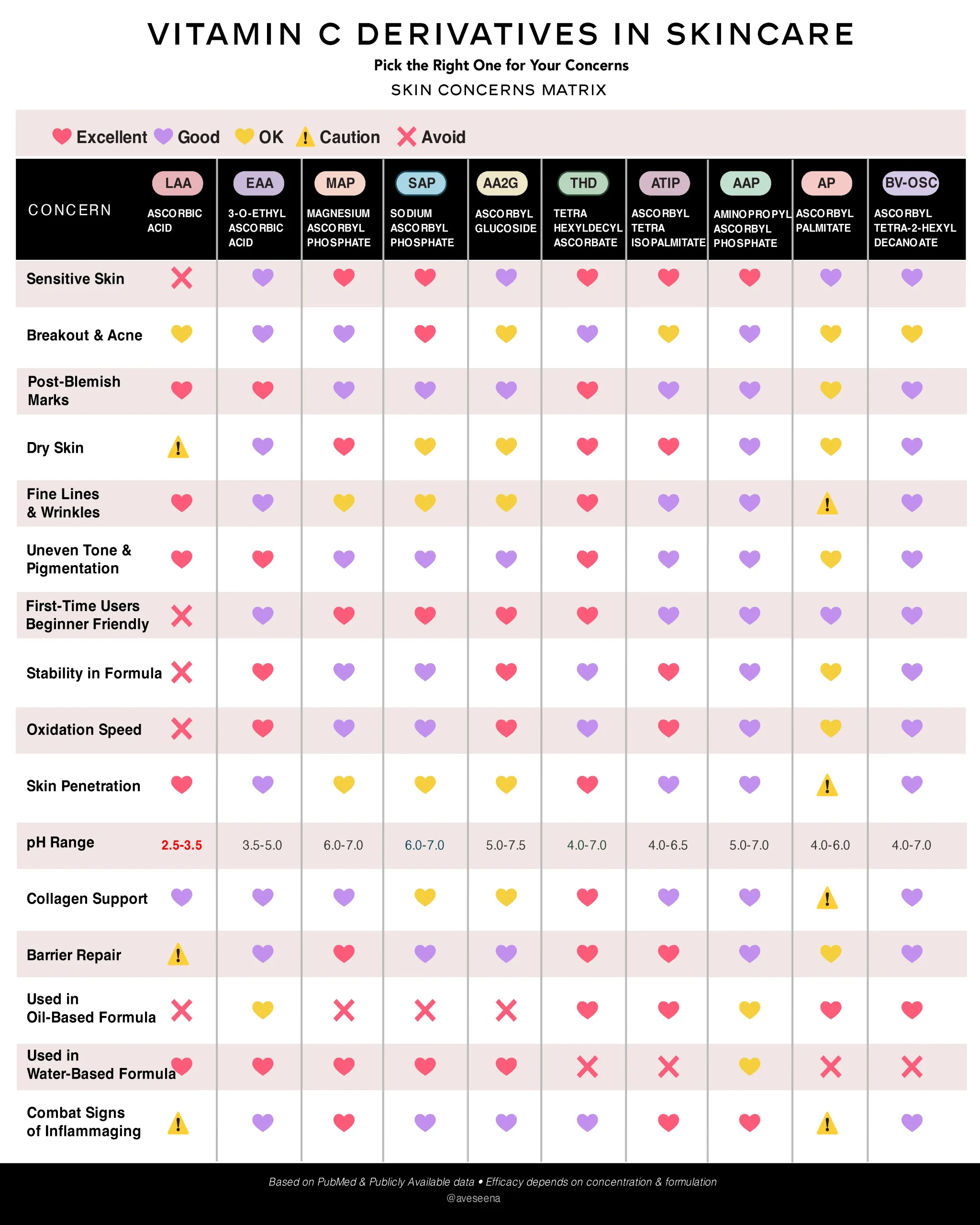
L‑Ascorbic Acid is most effective at pH 2.5–3.5 — highly acidic and often uncomfortable for reactive skin — and it destabilizes quickly in many everyday formulas.
THE SKIN CONCERNS MATRIX
Sensitive Skin
If your skin is reactive or has a fragile barrier, classic L‑Ascorbic Acid is often the hardest formula to live with. Its very low pH can feel harsh and tight. Gentler options include MAP (around pH 7.0), SAP (pH 6.0–7.0), and THD (pH 4.0–7.0), which allow more comfortable, long‑term use.
Blemish‑Prone Skin
For breakout‑prone complexions, SAP (Sodium Ascorbyl Phosphate) stands out. Studies have shown SAP can help support clearer‑looking skin and a more balanced‑feeling surface when used consistently.
Fine Lines & Wrinkles
If your main concern is visible firmness and smoothness, oil‑soluble forms are key — THD, ATIP, EAA. These derivatives are designed to move into the lipid phase of skin, where they can better support a plump, resilient look over time.
Uneven Tone & Dark Spots
Here, stability and consistency matter more than chasing huge percentages. A stable derivative like SAP used daily at an appropriate level over many weeks will beat a strong L‑Ascorbic Acid serum that degrades within days.
Your Vitamin C routine, without guesswork
Instead of gambling on ten derivatives, AveSeena built one Vitamin C system around THD and SAP that matches what this matrix points to: comfort, stability, and realistic daily use.
Match your concern to a concrete next step- ✓ Sensitive or easily flushed: SAP in Ageless Perfection Cream to keep radiance and comfort in the same jar.
- ✓ Dry or mature: THD in Green Caviar Oil Elixir to wrap the lipid barrier in a soft, replenished feel.
- ✓ Blemish‑prone: SAP in Gentle Gardenia Anti‑Pollution Gel Cleanser to bring Vitamin C‑minded care into the very first cleanse.
We all deserve science‑backed skincare, not marketing hype.
UNDERSTANDING SOLUBILITY: VITAMIN C DERIVATIVES
Water‑Soluble Forms
LAA, EAA, MAP, SAP, AA2G
Often used for radiance, oil‑balance support, and blemish‑prone routines. These typically live in water‑based serums and essences.
Oil‑Soluble Forms
THD, ATIP, AP, BV‑OSC, AAP
Often chosen for visible firmness, barrier comfort, and drier or more mature skin. These usually appear in oil‑based formulas and emulsions.
THE AVESEENA APPROACH
At AveSeena, there is a deliberate choice: we work with THD and SAP — and do not rely on classic L‑Ascorbic Acid.
That decision comes from the lab bench, not the marketing brief: choosing Vitamin C forms that skin can live with comfortably, long term.

Green Caviar Oil Elixir · THD
A facial oil enriched with THD for lipid‑phase Vitamin C support, designed to cushion and soften the look of dry, depleted skin.
Best for: All skin types, especially dry or mature.
See how this oil completes your Vitamin C stepsAgeless Perfection Cream · SAP
A cocooning cream featuring SAP for gentle radiance and daily comfort, created with sensitive‑leaning skin in mind.
Best for: Brightening, comfort, everyday use.
See how this cream locks in your Vitamin CGentle Gardenia Anti‑Pollution Gel Cleanser · SAP
A cleanser formulated to remove daily buildup while introducing antioxidant‑minded SAP from the very first step.
Best for: All skin types, including many blemish‑prone routines.
See how this cleanse starts your Vitamin C system
Molecular Immunologist & Skincare Expert
As an Immunologist trained in Molecular Medicine and as an expert in skin care and cosmetic chemistry, Dr. Ebru Karpuzoglu has spent +20 years researching skin, impact of hormones on the immune system sharing her findings in international publications with her audience, and building an award-winning line of products. Trusted by scientists, doctors, editors, bloggers, celebrities and skincare lovers around the world, her deep real-world knowledge and research are invested in every drop of AveSeena.
Scientific references include:
- Pullar JM, Carr AC, Vissers MCM. The Roles of Vitamin C in Skin Health. Nutrients. 2017.
- Telang PS. Vitamin C in dermatology. Indian Dermatol Online J. 2013.
- Stamford NP. Stability, transdermal penetration, and cutaneous effects of ascorbic acid and its derivatives. J Cosmet Dermatol. 2012.
- Klock J et al. Studies on topical vitamin C: stability and efficacy. Int J Cosmet Sci. 2005.
- Pinnell SR et al. Topical vitamin C and photoaging. Dermatol Surg. 2001.