Period After Opening: How Long Your Skincare Really Lasts
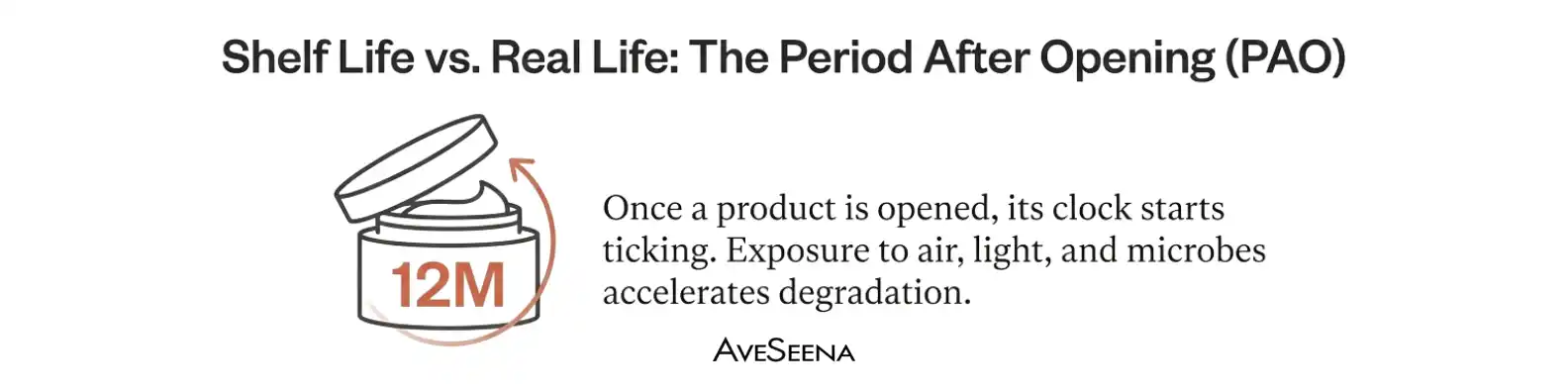
That small open-jar symbol on your products is the PAO. It tells you how long a formula stays safe and effective after you first open it. Here is how to read it, store smart, and know when to let go.
The period after opening refers to the amount of time that elapses between the moment you open a product and the first use of it. This time varies depending on the type of product and how it was stored.

A clean reset for a shelf full of question marks.
If you landed here because you are not sure what is still safe to use, this is the low-commitment fix: six sealed AveSeena travel sizes, each with its own open-jar PAO, so you always know what you opened and when.
Six formulas · $25.50 · 15% off your next full size
Meet the Six That Do the WorkPAO Means Period After Opening
If you store your products properly, you should see little difference in the effectiveness of your products after the initial opening. However, some products will lose their potency faster than others.
Products that are exposed to light, heat, moisture, or oxygen will lose their potency much quicker than those kept in a cool, dark space. For instance, if you store your products in an airtight container, they will last longer than those left exposed to air.
The best way to ensure that your products remain potent is to keep them in a cool, dark place, away from direct sunlight and heat. Close them tightly after every use, and rotate what you own so nothing sits half-used past its window.

How Long Does a Product Stay Effective?
PAO refers to the period of time after opening during which a product remains safe and stable to use. It varies by product type and storage method. For example, toners with alcohol tend to behave differently over time than water-based formulas without it.
PAO values commonly range from a few months to a year or more. When you buy a new product, check the label for the open-jar symbol. If there is no PAO shown and no best-before date, do not assume it lasts indefinitely. Contact the producer or choose an alternative that clearly shows one. And if a product has visibly changed in smell, color, or texture, discard it.
Why PAO Matters When Choosing Skincare
PAO is a safety and stability marker, not a marketing detail. A shorter PAO often signals a gentler, less heavily preserved formula or more perishable active ingredients, which is not a flaw, but it does mean the product needs to be used within its window and stored carefully.
The point that gets missed most: the Australian Competition and Consumer Commission reported that many people only replace skincare once they run out, not when it has passed its PAO. Using a product well beyond that window is where irritation and contamination risk begin.
Quick Answer: What Is PAO?
PAO stands for Period After Opening. It is the open-jar symbol with a number and the letter M (for example, 12M) that tells you how many months a product stays safe to use after you first open it.
In the EU, under Regulation (EC) No 1223/2009, the PAO symbol is required on products with a shelf life over 30 months. Products lasting 30 months or less show a best-before date instead.
The Best Way to Keep Skincare Fresh
Whether it is a moisturizer, a face serum, or an eye cream, a few precautions keep your skincare working at its best. As a general guide, the Period After Opening is often around 12 months for moisturizers, serums, and related products. Kept closed and stored well, many products hold up to around 24 months, but only under the conditions below.
- Always close jars and bottles after use, and do not let water or humidity get into the product.
- Avoid exposing products to sunlight, which breaks down the integrity of the formula.
- Keep products away from heat sources such as radiators, sunny windowsills, a hot car, or a beach bag.
- Wash your hands before use, and use a clean spatula to take product out of a jar.
A Personal Guide to Keeping Products in Shape
Getting the most out of your skincare takes a little more than slathering it on and hoping for the best. A few habits keep your products in tip-top shape:
1. Hands off, please. Dipping fingers into creams and serums invites bacteria where they do not belong. Wash your hands first. This is why we include stainless steel spatulas with our Ageless Perfection Cream and Honeyactive Beauty Mask.
2. Find the sweet spot. Your skincare has a comfort zone, temperature wise. Too hot or too cold and its performance suffers. A cool, stable environment is key.
3. Cleanliness matters. Applicators and brushes turn into bacteria carriers if not cleaned regularly. Give them their own little spa day after use to keep your routine safe and effective.
4. Steer clear of the sun. Direct sunlight and moisture make products go bad faster, changing texture and scent. A cool, dry spot away from windows is their happy place.
These steps keep your products from expiring before their PAO, and keep them safe and effective for your skin.
What About PAO and Makeup?

In 2013, an investigation in the International Journal of Cosmetic Science looked closely at the beauty habits of a group of young women. The finding that raised eyebrows: a large share were using expired makeup, particularly eye products like mascara, eyeliner, and eyeshadow.
Using expired makeup, especially around the sensitive eye area, is concerning for several reasons, and it is exactly why PAO matters. Over time, makeup can harbor bacteria and fungi, which, when applied, can lead to irritation, infection, and more serious eye issues. The risk is most pronounced with products used close to the eye. Expired makeup can also change in texture, color, and performance. Do not use makeup past its PAO.
Most people replace skincare when it runs out, not when it expires. That gap is where the risk lives.
Brief Guide for PAO and Expiration Date
Here is a brief cheat sheet on how long products stay effective before and after opening. Pay attention to both the PAO and the expiration or best-before date noted on your products.

Why PAO Is Critical for Preventing Irritation and Sensitivity
The Period After Opening is critical in preventing skin irritation and sensitivities for several reasons:
Degradation of active ingredients. Active ingredients can degrade over time, losing efficacy. If a product no longer performs as intended, it can leave skin under-protected. For instance, expired sunscreen may not provide adequate UV protection, increasing the risk of sunburn and related damage.
Preservative effectiveness. Skincare and cosmetic products contain preservatives to inhibit the growth of bacteria, fungi, and other pathogens. Once those preservatives lose effectiveness after the PAO, a product can become contaminated, which can lead to infection, irritation, and allergic reactions.
Chemical changes. Over time, chemical changes can occur, especially after exposure to air, light, or heat. These changes can produce new compounds that may irritate the skin or trigger allergic reactions, particularly in sensitive individuals.
Contamination with use. Each time a product is used, it is exposed to contaminants from skin, air, or applicators. Used beyond its PAO, that contamination can build, raising the risk of irritation or infection with each application.
What Happens if You Use Expired Skincare?
Using expired skincare can have several negative effects on the skin:
- Infections: Bacterial or fungal contaminants can cause skin infections, with redness, swelling, and pain.
- Irritations: Chemical changes or ingredient degradation can irritate the skin, leading to redness, itching, or rash.
- Allergic reactions: New compounds formed through degradation or contamination may trigger allergic reactions such as itching, hives, or dermatitis.
- Acne breakouts: Contaminated products can clog pores and promote the growth of acne-causing bacteria.
- Reduced effectiveness: Expired products may underperform, leaving skin concerns undertreated and skin under-protected.

What About AveSeena's PAO?
On the back of our skincare packaging you will find the open-jar PAO symbol, showing how long the product stays safe after opening. Every AveSeena product also goes through serious stability testing and dermatologist approval, so your skin gets the healthiest, most effective formula for its full window. If your current shelf is a mix of half-used jars with no clear dates, the simplest reset is to start fresh with sealed, dated sizes.
Not sure what is still good on your shelf? Start clean with six sealed formulas, each with its own PAO, so you always know what you opened and when.
See the Discovery KitFrequently Asked Questions
What does PAO mean on skincare products?
PAO stands for Period After Opening. It is the open-jar symbol with a number and the letter M, for example 12M, that tells you how many months a product stays safe and effective after you first open it.
How long does skincare last after opening?
It depends on the product and how you store it. As a general guide, moisturizers, serums, and eye creams often carry a PAO of about 12 months, and unopened they can keep for up to around 24 months when stored cool, dark, and dry. Always check the open-jar symbol on your specific product.
Is the PAO symbol legally required?
In the European Union, under Regulation (EC) No 1223/2009, products with a shelf life over 30 months must display the open-jar PAO symbol, while products lasting 30 months or less show a best-before date instead. The US FDA does not require expiration or PAO labeling, so that responsibility sits with the manufacturer.
Can I still use a product after its PAO?
It is not recommended. After the PAO, preservatives lose effectiveness and the product becomes more prone to bacterial and fungal contamination, which can lead to irritation, breakouts, or infection, especially near the eyes.
How should I store skincare so it lasts?
Keep products in a cool, dark, dry place, away from sunlight, heat, and humidity. Close lids tightly after each use, wash your hands first, and use a clean spatula for jars instead of your fingers.
How do I know when to replace my products?
Check the open-jar PAO symbol and note the month you opened it. Also watch for changes in smell, color, or texture, which are signs to stop. If you are not sure what is still safe on your shelf, starting fresh with sealed, dated sizes removes the guesswork.
Contamination Is Not Hypothetical
The reason PAO exists is not paperwork. It is contamination, and it happens to well-known brands, not just forgotten drugstore jars.
On July 1, 2026, Kao USA issued a voluntary recall of specific lots of Oribe Serene Scalp Densifying Shampoo, a salon product that retails around $52, in the United States and Canada, after the bacterium Pluralibacter gergoviae was detected. The FDA posted the notice. That bacterium is notable because it resists many of the preservatives commonly used across the cosmetics industry, which is exactly why a preservative system has to be tested, not assumed.
It is not an isolated case. The industry has seen preservative and quality failures before, including the widely reported Drunk Elephant situation. We covered what that episode reveals about formulation and preservative safety in our analysis of the Drunk Elephant recall.
The point is not that these are bad brands. The point is that a product looks and smells fine long after its preservative system stops protecting it, and that a clear PAO plus a preservative system that passes challenge testing is what stands between your skin and the outcomes listed above. Every AveSeena formula carries an open-jar PAO, is dermatologist-tested, and is made in small, well-preserved batches for that reason.
About the Author
Dr. Ebru Karpuzoglu, PhD is an immunologist, molecular medicine specialist, and the founder of AveSeena. Her peer-reviewed research on inflammaging, T cell biology, and endocrine-immune interactions is published in journals including Frontiers in Immunology. She formulates every AveSeena product based on three decades of laboratory and clinical research.
Scientific References:
1. Michalek IM, John SM, Caetano Dos Santos FL. Microbiological contamination of cosmetic products, observations from Europe, 2005-2018. J Eur Acad Dermatol Venereol. 2019 Nov;33(11):2151-2157. PMID: 31166041
2. Farage MA, Katsarou A, Maibach HI. Sensory, clinical and physiological factors in sensitive skin: a review. Contact Dermatitis. 2006;55. Full text
3. Guest S, McGlone F, Hopkinson A, Schendel ZA, Blot K, Essick GP. Perceptual and sensory-functional consequences of skin care products. J Cosmet Dermatol Sci Appl. 2013;3(1A). Full text
4. Fan L, He C, Jiang L, Bi Y, Dong Y, Jia Y. Brief analysis of causes of sensitive skin and advances in evaluation of anti-allergic activity of cosmetic products. Int J Cosmet Sci. 2016 Apr;38(2):120-7. PMID: 26444676
5. ACCC analytical survey of microbiological contamination of cosmetics for use around the eyes. Australian Competition and Consumer Commission
6. Giacomel CB, Dartora G, Dienfethaeler HS, Haas SE. Investigation on the use of expired make-up and microbiological contamination of mascaras. Int J Cosmet Sci. 2013 Aug;35(4):375-80. PMID: 23590385
7. Kao USA Inc. Voluntary recall of Oribe Serene Scalp Densifying Shampoo due to Pluralibacter gergoviae contamination. U.S. Food and Drug Administration recall notice, July 2026.
This article is for educational purposes only and does not constitute medical advice. All information stated here, including regulatory details and product recall notices, is drawn from openly available web and public sources, including the U.S. Food and Drug Administration, the European Commission, and peer-reviewed literature cited above. Product recalls referenced are limited to the specific lots identified by the manufacturer and regulator; they do not indicate that a brand's entire product line is affected. Individual results may vary. Consult a qualified professional for concerns specific to your skin or health.